Sunday, 14 February 2021

 Samarqand


Prologue

A cloud of dust and shower of stones as the vehicle lurched to a halt. Unexpected road repairs ensured no easy exit. Quickly reversing, the taxi was soon weaving its way back through the labyrinth of narrow alleys, carefully avoiding the army and police checkpoints.

Preparation

No ...... This is not a modern spy thriller. It is just a reflection on actual events that occurred in August-September 2016, recorded without exaggeration or distortion, as witnessed by the author
[1]
 while travelling in central Asia. [2] [3]

''Why do you want to go to Central Asia?'' This was the question we were constantly asked while we prepared to travel to western China, Kazakhstan, Kyrgyzstan and Uzbekistan. The answer of course was, ''because we haven't been there yet''. But a more truthful answer would have been, ''because it was the hub of the great Silk Road connecting China with Europe for over two millennia.'' More than any other corridor of trade and conquest, this route has advanced our civilizations, both east and west. The history of the Silk Road is our history..... We are who we are because of the merchants and conquerors who traversed the road.

The term ''Silk Road'' is a modern term, first coined by Ferdinand von Rictoffen (uncle of the World War I air ace). There were actually many roads in the Silk Road network, used for intercontinental trade since the age when Han Chinese goods found their way into aristocratic Roman households. Most of the land trade routes passed through the region now encompassing western China and modern Kazakhstan, Kyrgyzstan and Uzbekistan, and this was our intended destination. 


These land routes were in constant use until finally displaced by sea trade, which increased progressively from the early sixteenth century. The sea route between India and western Europe via the Indian Ocean and southern Africa was pioneered by the Portuguese following Vasco da Gama's 1497-1499 voyage, while a competing sea route from Philippines to Europe via the Pacific, Panama (land transhipment) and the Atlantic was developed by the Spanish in the late 1500's following Ferdinand Magellan's epic 1519-1522 voyage.

To truly understand the world in which we live, it is first necessary to understand the world of our forebears and the trade routes that they traversed.

Guangzhou     
So we were off…. and after a long flight we finally landed in Guangzhou. This was my third trip to China, the first many years ago as a tourist and more recently on business – six days in six cities, in and out of factories that testify political firmness, foresight, investment in modern technology and a penchant for hard work can combine to make a modern manufacturing-based prosperous society.
But enough of that – we were on holidays this time.
For us, Guangzhou was but a staging post on our journey to the Silk Road, although we lingered long enough for two nights of good sleep bookending an enlightening city tour.
I suppose all city tours are the same …… a couple of old religious buildings, (churches, temples or mosques depending on whether you travel the occident, the orient or in between), ancient forts and battlements (usually spruced up in response to a service life of hardship and a retirement of neglect) and the inevitable dose of local craft and souvenir shops.
But on closer examination, Guangzhou was more relevant to the Silk Road than it first appeared. The Silk Road comprised the land routes that connected China and Europe for almost two millennia, the trading corridors though which the camel caravans dispensed goods, wealth and ideas. When caravels[4] finally displaced the caravans, it was to sea ports such as Guangzhou that these Portuguese ships journeyed.
     

Guangzhou Waterfront                                                                       Chinese Tea Ceremony
Since the late-fifteenth century the Chinese Ming dynasty had been in inexorable decline, the bureaucracy systematically stifling the international inquisitiveness of Chinese maritime traders. Just when Europe was expanding, China was contracting. The usurping of power by the Qing Dynasty in 1644 failed to arrest this decline, and by the time that the Europeans appeared in the area, China was ripe for exploitation.
Malacca (in present day Malaysia), which had hither-to been a Chinese vassal, had been conquered in 1511 by the Portuguese and a trading post established. In 1516, Rafael Perestrello journeyed from Malacca to Guangzhou, followed a year later by an eight-ship expedition led by Fernao Pires de Andrade. However, Andrade was defeated by the Chinese Ming forces, and it was not until 1554 that Leonel de Sousa bribed the Chinese admiral Wang Bo, facilitating the Luso-Chinese Accord. Portuguese trade was thus secured and relocated to nearby Macau, first as a trading post and then in 1887 as a colony, a status it retained until reverting to Chinese sovereignty in 1999.[5]
With the Portuguese traders diverted to Macau, Guangzhou attracted the attention of the other European powers, principally the British. The prized commodity was Chinese tea, but how could the British pay for it? The solution – wage two wars, First Opium War(1839–1842) and the Second Opium War (1856–1860), to force the Chinese to accept Indian-grown opium as payment for Chinese-grown tea[6] …… tea for free ! ……. Drug trafficking has a long pedigree.[7] 

 UrumqiOne sure way to combat boredom of a four hour flight is to read the in-flight magazine, …. but to an air traveller unschooled in interpreting the Chinese script, negotiating the in-flight magazine of the Chinese domestic airlines can be a challenge. Fortunately one article appeared in both Chinese and English …. a sort of modern Rosetta Stone. Look for a commonly occurring word in the English text and find the corresponding Chinese symbols. The article in question was about the great museums of the world and their role as the oracles through which the lessons of civilization are conveyed down the millennia. In the English version the words “China” and “civilization” appeared in many places, but in the Chinese version they appeared to be almost interchangeable.


The most common sinitic name for China is zhonggua, denoted by the characters, the symbols meaning “middle” and “state” respectively, and differentiating between the cultural central region of the Yellow River valley and the barbarous periphery. During the Zhou and Han dynasties (spanning the period 1046 BC to 220 AD), zhongguo was accepted as the "center of civilization" or "center of the world".
Pride is admirable, but arrogance is fatal ….. and there is but a fine line between the two. While China’s proud cultural heritage was (and is) the envy of the civilized world, the growing arrogance of the Ming and Qing dynasties fuelled the introspection that witnessed their decline in the 17th to 20th centuries. And which countries are following suit is the 21st century?
The four hour morning flight from Guangzhou to Urumqi in the far west is a reminder of just how vast modern China is. Unlike other large countries, China has only a single time zone, resulting in long western afternoons of brilliant daylight. With plenty of time to spare, we decided to try our luck with the airport bus rather than catch a taxi to our hotel. While this may have “sounded like a good idea at the time”, the execution was less than ideal. We do not speak Mandarin and few people in the west speak English. Having failed to exit at the appropriate stop, it finally dawned on us that we should alight when the bus pulled into the terminus at the central station. That I had failed to identify the location of our hotel on a map …. any map …. resulted in four hour “walking tour” of this large modern city. Perhaps with uncharacteristic foresight, we had opted for “carry-on luggage” only, which provided some relief. After a belated lunch and some directions at a friendly fast-food chicken shop, we finally surrendered to the inevitable and summoned a taxi. Five minutes later we were at the hotel.     

The north eastern Dzungaria region (inhabited by Tibetan-Buddhist Dzungar nomads) and the south-western Tarim Basin (inhabited by Turkic-speaking Muslim Uyghur sedentary farmers) existed separately before being united to form Xinjiang by the Qing dynasty in 1884. The Tarim Basin is rich in oil and gas, and China seeks to supply approximately a fifth of the country’s consumption from this region.[8] One cannot fail to be impressed by the abundance of power stations, factories and blast furnaces along the freeway.
Urumqi is a large modern city, capital of the Xinjiang Uyghur Autonomous Region, and populated mostly by Han Chinese who have migrated from the east.[9] The demographic data is telling – In Urumqi 75% of the 3 million population is Han Chinese while only 13% is indigenous Uyghur. However, in the Xinjiang as a whole, only 41% of the 22 million population is Han Chinese while 44% is Uyghur.[10] This, with the presence of the vast energy resources, has given rise to an acute separatist problem - the police, army and security are omnipresent.
The Uyghur separatist movement claims that the region was invaded by China in 1949 and has been under subsequent Chinese occupation. While the Uyghurs of Xinjiang are linguistically and culturally Turkic and Muslim, the Han Chinese speak Mandarin and mainly adhere to Buddhism, Confucianism or Taoism. Although religious practice is tolerated, the government of the People's Republic of China does not formally endorse or support any religions.  
Although movement around Urumqi was not restricted, one does become conscious of the military convoys moving down the highway, the police post in front of the hotel and the groups of police wandering through the hotel lobby. As if to reflect the security concerns in the city, airport security at Urumqi was the strictest that we encountered. Not only must you remove all items from your pockets, your belt and your shoes; but you must also expose the soles of you feet to the metal detector. And this is not without justification. While we did not witness any violence in China, we were in Bishkek (capital of Kyrgyzstan) a week later when the Chinese embassy was bombed (allegedly) by Uyghur separatists.
The 2005 Kyrgyzstan Tulip Revolution ushered in a period of political instability in the region with Xinjiang suffering increasing Uyghur militancy and terrorism. Chinese authorities have clamped down, as witness by the decree that men with long beards and  women wearing veils be discouraged.[11] [12]
We were not part of any organised tour (you could say we were quite disorganised), and we believe that this attracted the attention (“assistance”), of the security service. A well dressed gentleman (claiming to be part of the hotel management … but we are not so sure) insisted on “helping” us to join an organised day-trip to Heavenly Lake.
This excursion is the highlight of any visit to Urumqi, popular with the many tourists from eastern China. The spectacular natural scenery of the eastern Tien Shan Range and the serene glacial lake was augmented by a spectacular open-air show of cultural and gymnastic prowess that only the Chinese can perfect …. a most enjoyable day.


Heavenly Lake                                                   As only the Chinese could do …!


Urumqi (from the hotel)


The following morning the same gentleman kindly organised our trip to the Xinjiang Regional Museum, accompanied by a young man (“companion” or “minder” ….. what is the difference?) who (while clearly not a guide) kept a close eye on us to ensure that we did not stray too far and that we returned safely to our hotel.  
The highlight of this museum is its display of 21 ancient mummies[13] dating back approximately 4,000 years. Preserved by the extremely dry conditions of the Tarim Basin, the mummies, their burial practices and their woven clothing point to an origin quite unexpected in this region. The evidence suggests that these Tokharian people were Indo-European (not Asian), related to the Celts who settled in Western Europe. A related Indo-European nomadic people, the Yuezhi, were pushed westward into the Tarim Basin following the defeat in 170 BC by the Xiongnu (Altaic nomads)[14]. Subsequent invasions by Han Chinese were followed by the Uyghurs (a Turkic people) in the 7th century AD and more recently by the Chinese Tang, Ming and Qing dynasties.[15] That these peoples were successively victorious and then displaced testifies to the volatility of the region and to the historical fragility of land claims in general. Perhaps none of us can legitimately claim exclusive land rights ….. Is history simply telling us to use it or lose it?
Coffee is the life-blood of the modern traveller; but in a region where tea is ubiquitous, coffee must be considered a luxury. In days of old, Silk Road traders would pay enormous sums for luxury items; in our case each coffee at Urumqi International Airport cost the same as the taxi fare from the city!

Farewell China ….. Hello Kazakhstan.

Almaty Almaty – largest city and former capital of Kazakhstan. Here we joined our formal three-week tour of three of the “stans” (Kazakhstan, Kyrgyzstan and Uzbekistan), here we met our travelling companions and here we met the first of our two delightful guides.  Travel in the company of friendly and adventurous companions is always fun, and we were blessed with the best.
Almaty is a modern clean city with an impressive mountain backdrop on the northern edge of the Tien Shan range. What impresses most is the unexpected modernity of the city, the tall buildings, the moderate but well disciplined traffic and the apparent affluence of the people. The wealthy have homes nestling above the city in northern slopes of the Tien Shan, while the less affluent have homes below the city on the edge of the vast central Asian steppe. 


Tien Shan of the Almaty hinterland                                                         World War II
As a tourist, there are some aspects of a country that are difficult to gauge. For example, Kazakhstan is considered by the World Bank and the World Economic forum to have a severe corruption problem, although, as tourists, we were oblivious to such concerns.[16]


The city boasts a diversity of attractions, the Green Market, the renovated Russian Orthodox cathedral, the historical museum, the music museum and the war memorial …. No ex-soviet republic would be complete without one. The highlights of this introductory tour include the skating rink enfolded within the Tien Shan slopes and the lookout and entertainment area overlooking the city. A timely reminder of the cultural diversity and richness of this region was an open-air opera rehearsal being conducted as the sun set over the city below.


Leaving Almaty, we headed north-east skirting the edge of the Tien Shan along the old Northern Silk Road. Although a geographically the simplest route, this road was the least favoured by the traders of old, because it exposed the travellers to the onslaughts of marauding nomadic Mongols, sweeping down from the north across the broad Asian steppe. To avoid these attacks, the caravans often turned south, crossing the Tien Shan though a series of passes such as that at the head Charyn Canyon. This canyon is an 80 kilometre long series of slashes of spectacular grandeur in red sandstone plateau. Today the grasslands of the steppe are peaceful, and the northern corridor is favoured for the east-west rail and road trade between Europe and China rather than this shortcut into the remote mountain region of north-eastern Kyrgyzstan.


Charyn Canyon                                                  Kazakh Steppe

Kara Kol
Entry into Kyrgyzstan from the north-east is illuminating, a gentle reminder that this mountainous republic is still very much a rural-based society, in which pastoralists venture into the hills each summer to tend their flocks. While modern caravans and trucks are in evidence, the yurt (the antecedent of the modern dome tent) is still the preferred accommodation option and the horse is still the most effective means of managing the flocks. 


Yurts, bee hives and droving in rural Kyrgyzstan

But it would be wrong to assume that all rural activities are stuck in the past. We were warmly welcomed to dinner at a modern horse stud, owned and operated by a very proud husband and wife team, who have built a flourishing business during the last 25 years. With three horses entered in the second World Nomad Games (to be held within a week in nearby Cholpon-Atawithinon on the edge Issyk Kul Lake) this couple have much justification for pride.  

The history of Karakol is the history of Russian penetration of the region. Founded in 1869, it grew steadily with the arrival of Chinese Muslim Dungan refugees. On the shores of nearby Issyk Kul Lake is a memorial to the Russian explorer, Nicholay Przhevalsky, who died here of typhoid in 1888. Przhevalsky was renowned for his journeys through northern, eastern and central Asia, but he failed in his ultimate goal of reaching Tibet.[17] Instead, the first European penetration of Tibet was accomplished by the 1903-1904 British invasion led by Francis Younghusband, which resulted in between 2,000 and 3,000 Tibetan deaths .... a stark reminder of the brutality of the so-called “Great Game” played out in central Asia between Britain and Russia over a century ago.[18]
The attractions of northern Kyrgyzstan are many – Jeti Oguz Valley, Issyk Kul Lake and Chon Kemin National Park; and a couple of laid-back days of sight-seeing, walking and horse riding were very enjoyable.

Bishkek
From Shabdan in the Chon Kemin National Park to Bishkek, the road is significantly improved compared to the pot-holed rural roads elsewhere in the country.


Burana Tower – Chuy Valley             Near Bishkek

Like other large cities of central Asia, Bishkek is clean and tidy, complete with monuments and museums to commemorate the last 25 years since independence from the Soviet Union. Although we were not in the city for the 25th year celebrations, we were fortunate to witness the rehearsal …. bands playing stirring martial music, precision marching and the salute taken from a couple of aged convertible automobiles.


Byubyusara Beyshenalieva        Vladimir Lenin – Bishkek            Aykol Manas - Bishkek
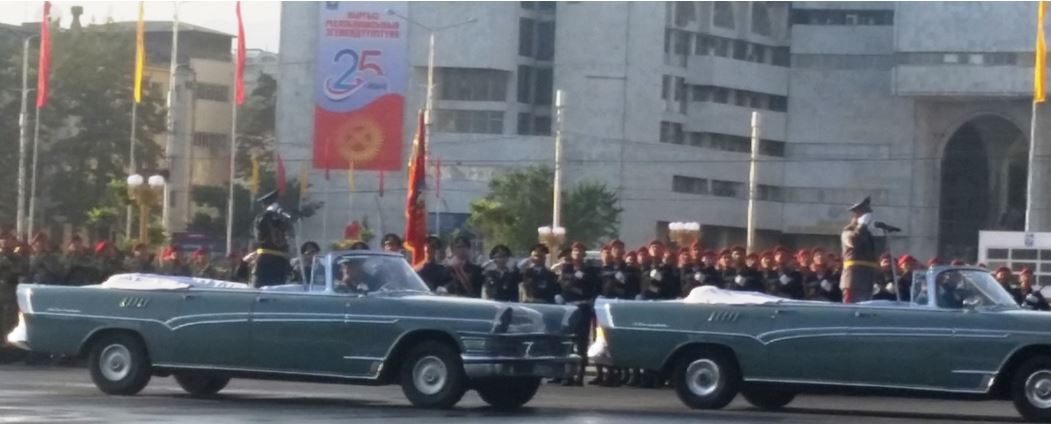
25 Years of Independence from the Soviet Union - Bishkek        

Tashkent
Despite an early morning dash to the airport and the unsettling news that the Chinese embassy in Bishkek have been bombed, our departure for Tashkent went smoothly, with impressive views to the south of the snow-capped Tien Shan. Clearing Tashkent airport, we met our new guide who proved over the next couple of days to be a most resourceful and caring travelling companion.
First impressions of Tashkent are the broad tree-lined streets with hardly a trace of litter, for reasons that would become apparent in the next couple of days. For the time being, we settled down to a walking tour of the usual sights, the immaculate metro stations, the Monument of Courage commemorating the victims of the devastating 1966 earthquake, the memorial to the sacrifices of the Second World War (celebrated here as 1941, not 1939, to 1945). And then it got interesting.  


Monument of Courage – Tashkent                      Independence Square – Tashkent
Due to a succession of Independence Day wreath-laying ceremonies, our access to the Independence Monument via the main entrance in was restricted, but we were advised that we could gain entry from the side. Undeterred, we skirted the official activities, only to be accosted, not by the police (as expected), but by a couple of television crews. “What do you think of Uzbekistan? What do you like about Tashkent? What would you like to say to the people?” and so on. Never the shrinking-violets and undeterred by the fact the we had been in the country a whole four hours, we both rose to the occasion. “Thank you for the warm welcome. What a beautiful city. Congratulations on 25 years of independence …. blah, blah, blah ….”. While we know roughly what we said, to this day we have no idea how the voice-over translated it. Presumably, because there were no adverse repercussions, it must have been okay. The date was 31 August 2016.[19] [20]

Rod and Robyn on Uzbek National Television     Independence Monument (25 Year’s Independence)
Like all truly modern countries, Uzbekistan enjoys the luxury of a fast train service …. the new way to travel the Silk Road. The quick journey through the flat farmlands from modern Tashkent to historic Samarkand was both relaxing and interesting.


Fast train from Tashkent to Samarkand 

Samarqand
For nearly three millennia, Samarkand has endured invasion after invasion. Most likely founded between the 8th and 7th centuries BC, the city was incorporated into the Achaemenid (Persian) Empire (550 to 330 BC) as the Sogdian Satrapy.
Next came Alexander (Greek) in 329 BC, and his Hellenistic successors, the Seleucid Empire, the Greco-Bactrian Kingdom and Kushan Empire.
The Sassanians conquered Samarkand around 260 AD, then the Hephtalites and the Turks, who were obliged to pay tribute to the Chinese Tang Dynasty. During this period a number of religions flourished in Samarkand, including Buddhism, Zoroastrianism, Hinduism, Manichaeism, Judaism, and Nestorian Christianity.
Eventually the Arab Muslim armies of the Baghdad Umayyad Caliphate defeated the Turks to capture Samarkand around 710 AD. Ruled successively by the Abbasids (750 to 861 AD) and then the Samanids (862 to 999 AD), Samarkand eventually succumbed to the Turkic Karakhanids, who were followed by other Turkic peoples, the Seljuqs and the Khwarazm-Shahs.
In 1220, Genghis Khan (the Mongol, Temujin) conquered and pillaged Samarkand, which suffered a further Mongol sack by Khan Baraq. During this period it was part of the Mongol Chagatai Khanate.
In 1370, Timur (a.k.a. Tamerlane) expelled the Mongols and made Samarkand the capital of his empire. Following in the footsteps of Alexander and Genghis Khan, Timur set out to expand his empire from modern day Turkey in the west to China in the east. While Timur went close to this goal, his achievements were ephemeral. On Timur’s death in 1405 the empire fractured, to be finally supplanted in 1505 by the Shaybanid Uzbec warriors, who relocated their capital to Bukhara.
Attacked by Nadir Shah the city was abandoned in the 1720’s, to be ruled by the Ashtarkhanids and then the Manghyt emirs of Bukhara.
Samarqand passed to Russian control in 1886, Soviet control in 1925 and finally became part of independent Uzbekistan in 1991.[21]  
Of these invaders, it was Timur who has had the most lasting effect on Samarqand. Although the ravages of subsequent invasions and the natural elements have not been kind to his magnificent buildings, many have now been restored and serve as the symbols linking modern Uzbekistan with its Timurid past. These include Timur’s Mausoleum, the Registan madrasahs of Ulugh Beg, Sher-Dor and Tilya Kori and the Mosque of Bibi Khonym, Timur’s favourite wife. 


Registan Square – Samarkand                                       Ulug Beg and Observatory - Samarkand
Of religious significance, the Shah-i-Zindah avenue of mausoleums (constructed from the 9th to the 14th centuries, and then the 19th century) includes a mausoleum commemorating Kussam ibn Abbas, cousin of the prophet Muhammad.[22] 
On the death of Timur in 1405, his son, Shah Rukh, became ruler based in Herat, with his sixteen-year-old son, Ulugh Beg, installed in 1409 as governor in Samarkand. By 1411, Ulugh Beg was the sovereign ruler of the whole Mavarannahr khanate.
Ulugh Beg was no ordinary ruler; he was also a prominent scientist and an astronomer of note. Without the aid of telescopes, and working with a 36 metre radius sextant built within his Samarkand observatory, he achieved truly remarkable results. In 1437, Ulugh Beg compiled the accurate Zij-i-Sultani star catalogue of 994 stars, and determined the length of the sidereal year as 365d 6h 10m 8s (an error of only 58 seconds). This he later corrected to 365d 5h 49m 15s (an error of only 25 seconds), making it more accurate than Copernicus' estimate, which had an error of 30 seconds. He also calculated the tilt of the Earth's axis to be 23.52 degrees, more accurate than later measurements by both Copernicus and Tycho Brahe.[23]
From modern Uzbekistan’s perspective, 15th century Timur is a hero. With a fearsome reputation for cruelty, he was ruthlessly efficient in achieving his goals. For him, the ends always justify the means. The enormous and beautiful mausoleums, madrasahs and mosques testify to the wealth and prestige generated during Timur’s lifetime.


Timur – Tashkent                                   Timur’s Mausoleum – Samarkand

It is said that Timur was the role model for Uzbekistan President, Islam Karimov. First as Communist Party boss during the Soviet era, and then as President during the 25 years of independence, Karimov ruthlessly quashed all opposition to mould his country into a modern efficient state..... and not without some considerable success. Uzbekistan, with a population of 31.6 million and a GDP of   $ 5,939 per-capita  is ranked 125th in the world. But this has not been achieved without considerable pain. The IHF, Human Rights Watch, Amnesty International, United States Department of State and Council of the European Union define Uzbekistan as "an authoritarian state with limited civil rights" and express profound concern about "wide-scale violation of virtually all basic human rights".[24] In spite of (or perhaps because of) this fearsome reputation, Karimov appears to be loved by a substantial proportion of the population.
The national fetish for urban cleanliness is achieved by mobilizing (coercing ??) large teams of cleaners (mainly women) to assiduously apply their labour-intensive sweeping skills to this task. Perhaps there is but a fine line between civic pride and mindless obedience.
Our second day in Samarkand, 2 September 2016, was somewhat disrupted. From mid morning, we were amazed to see an incredible cleaning frenzy under way. Teams of women, some well dressed with high heels and others in more functional clothing, were quite literally hand-washing the pavements, sweeping and removing rubbish. And on a more robust scale, asphalt was being laid and concrete poured, all under the watchful eye and supervision by the police and civil guards. Clearly something had been afoot from quite early in the day.
As early as 27 August, there had been internet whispers that President Karimov was gravely ill, no … he had died, no … he was recovering, no …. he was in perfect health. But still the government would not clarify the situation. It was fascinating to follow the internet speculation as to whether he had …. or had not …. died.
President Karimov's 25th anniversary speech was read on television on 1 September by a presenter who stated that public support was helping him recover. According to a government report, on 2 September President Karimov “…was in stable neurological condition in a coma .....He suffered another cardiac arrest at 20:15 UZT on 2 September and attempts to resuscitate him failed, and he was pronounced dead at 20:55 UZT”.[25] [26]
But we had witnessed, a good 10 hours earlier, the well-advanced program in Samarkand of concrete construction at the funeral site, the frenzied cleaning the city, the laying of asphalt in access roads and the incredible build up in security. While I have great respect for project managers, to have mobilized this level of activity even before the official death announcement represents great forward planning. Where was the media scrutiny of this sequence of events?


President Karimov’s mausoleum and street cleaning – Samarkand – Midday 2 September 2016
The news late on 2 September that the President had died and would be buried the next day in Samarkand ….. barely three kilometres from our hotel …. was not necessarily welcome news. The funeral would be a huge international event. On the night of 2 September, Samarkand went into virtual lockdown. Police and guards were bussed in from other cities and stationed every 50 metres along the roads. Unauthorised persons were not allowed in and there were severe restrictions on the movement out. The main problem was that there was no indication how long the lockdown would remain. With travel commitments elsewhere, we decided it was time to break out.
Once again blessing our foresight in bringing only carry-on baggage, we trudged 4 kilometres to where we could hire taxis (at inordinately inflated rates) to drive us (at high speed) through the maze that is Samarkand’s back streets to where our on-going transport would be waiting.
A cloud of dust and shower of stones as the vehicle lurched to a halt. Unexpected road repairs ensured no easy exit. Quickly reversing, the taxi was soon weaving its way back through the labyrinth of narrow alleys, carefully avoiding the army and police checkpoints.
And finally, after two hours, when we had almost circumnavigated the city, we escaped the cordon and were free.
At no time were we in any danger and the inconvenience was fully compensated by the experience, but this incident was never-the-less disconcerting. That an entire people could be mobilized to such demonstrations of “affection” was something reminiscent of Europe in the 1930’s. Was the entire population still being manipulated from the grave?  

Bukhara
After the excitement of Samarkand, the trip returned to what one would expect of a reasonably conventional tour. The road trip over the mountains to Timur’s birthplace Shakhrisabz, and then on through the steppe to Bukhara was long and uneventful.
Like Samarkand, the ancient city of Bukhara was a major trading centre of the Silk Road. Highlights are the Ismail Samini Mausoleum, Khiva Gate, Friday Mosque, the Fortress, Kaylan Minaret, Kukeldash and Abdul Aziz Khan Madrasahs, the Char Minar and the Labiyabi Hauz Pool.


Labiyabi Hauz Pool, Kaylan Minaret, Kukeldash and Abdul Aziz Khan Madrasahs - Bukhara


It was here that one of the grizzly incidents of the Great Game was played out. The Great Game is the name given to the British and Russian intrigues and espionage as they vied for control of Central Asia in the 19th century, over 100 years before the similar American-British and Russian rivalry poisoned international cooperation. In 1844 after a lengthy imprisonment, two British officers Charles Stoddard and Arthur Conolly accused of spying were beheaded in the main square of Bukhara.[27]


Fortress Ark – Bukhara
Khiva
Between Bukhara and Khiva, the traveller becomes painfully aware of the hardships that faced the trading caravans of yester-year. Thanks to a partially built new highway, the Kara Kum (Black Desert) and the Qisel Kum (Red Desert) are traversed in less than a day. But such a journey would previously take three months by camel across the deserts with oases providing periodic respite along the way. To the south you see Turkmenistan across the mighty Oxus River, once the “Rubicon” of Alexander’s central Asian foray.


Amu Darya (Oxus River) in the Qisel Kum (Red Desert) looking towards Turkmenistan
With a history stretching back millennia, the walled city of Khiva was once a key trading centre on the Silk Road. Substantially rebuilt in the last few centuries, Khiva presents the tourist with a smorgasbord of mausoleums, madrasahs, mosques and minarets …… Kunya-Ark Palace, the Madrasah of Muhammad Amin-Khan, the Juma Mosque with its ornately carved forest of timber columns, the iconic unfinished Kalta Minar minaret, the 19th century soaring Islam Khoja Minaret and so on.[28] 

Khiva
Here also is the Mausoleum of Pakhlavani Mahmoud (1247-1326), the 13th century Sufi teacher and professional wrestler who reputedly never suffered a defeat during his 79 year career in Iran, Khorasan, India and other countries.  A man of both strong body and principle, Pakhlavani Mahmoud once disputed with the Emir of Samarkand and was imprisoned for his stand, stating in a quatrain written for the occasion, “….. to be left for ages in a dungeon is better than to have talks with immature.”[29] [30]
It is worth pondering that this region spawned so many poets, teachers, thinkers and scientists, a fact that we tend to ignore in our focus on modernity.

Tashkent ….. again
As our formal tour approached its conclusion, we flew back to Tashkent where we farewelled our travelling companions. After a fortnight of “full on” travelling, it was good to “chill out” for a couple of days …. riding the metro, exploring the shops and simply walking the leafy streets.

Tashkent


We had thoroughly enjoyed our central Asian trip. We had witnessed the unfolding of some political drama and learned a lot about people and their place in history. Above all, we had enjoyed the friendly and stimulating company of travelling companions and guides, and had been warmly welcomed by the friendly people of the region.
As if to footnote to this wonderful experience, we were waiting in the crowd to be admitted to Tashkent International Airport when we witnessed a man plucked from the crowd by the police and dragged away. We have no idea why …. whether he was a terrorist or a tout …. but we could hear him still screaming as he was taken away.

Seoul
New friendships are the most treasured outcomes on any travel. We had planned a couple of days of recreation in Seoul, South Korea, and were not disappointed. In Bishkek I had briefly met a fellow traveller from Seoul, who had offered to show us around when we reached his home country. The intensity of the hospitality and generosity extended by him and his wife was truly humbling. In a world where there is so much fear and suspicion, it is refreshing to find that openness, hospitality and friendship will blossom whenever the seed is planted and the flower nurtured. After two days of exploring Seoul, the shops of Insadong, Changdeokgung Palace and the metro to Soyosan in the outer suburbs, we were ready for home ….. a long flight at the end of a most rewarding holiday.  
Seoul


Reflection
A long plane trip is the ideal opportunity for reflection on recent experiences.
Central Asia is at the crossroads of the world, and the Silk Road is the artery that flows through it. Here have passed the Persians, Greeks, Arabs, Mongols, Turks, Chinese, Russians, Uzbeks, Kazakhs and Kyrgyz… and many others. Conquerors, traders, nomads and farmers … they have all passed this way, and our modernity is their legacy. People cannot ignore their history.
Making new friends requires a leap of faith, particularly when you meet in a strange and foreign place.  For over four decades we have travelled six continents, living on three of them and visiting over 70 countries[31]. Although blessed with international friendships that span two-thirds of a lifetime, we highly value the hospitality and generosity of our new Korean friends. People should offer friendship when they can and accept hospitality when it is offered. 
Instead of wasting valuable air time screening trivial interviews with a couple of ill-informed tourists, the Uzbekistan television media could have provided a much more valuable public service by investigating and reporting issues such as the power struggle likely to follow the death of the president and its implications for national security and wellbeing. Media laziness and bias should be at the forefront of our concerns… People must not be brainwashed by a biased media.
The excesses of the Central Asian authoritarian regimes are a stark reminder of the fragility of liberal democracy. While vote rigging, intimidation and torture are the most obvious abuses inflicted by governments, the ordinary people must also accept responsibility for compliant obedience as their freedom of independent thought is stripped away. People get the government that they deserve, and people must guard against the abuse of liberal democracy.
Following the death of Uzbekistan’s President Karimov, it is feared that a new leader may incite ethnic violence as a means of rallying the country. If so, the flashpoints would be the Kyrgyzstan / Uzbekistan border and the Fergana Valley. In many parts of the world, ethnic and religious differences are the trigger for violence and repression…. individual fears and selfishness are reflected in national paranoia and national selfishness.
Terrorism is now rife throughout the world, but it is born of (and feeds on) the intrigues and wars prosecuted by countries. Our closest brush with terrorism has been the tension of Xinjiang and the subsequent bombing of the Chinese embassy in Bishkek. However, it should not go unnoticed that in the 1980s China (like the western countries) trained and armed Uyghur fighters for Afghan resistance to Russian occupation[32] … and China now has a major problem with armed Uyghurs. The greatest threat to world security is war and state sponsorship of international violence.
Who will prevail, the poet Pakhlavani Mahmoud or the tyrant Emir of Samarkand?

Epilogue
A gentle bump and a puff of tyre smoke as the A330-300 touched down. Unexpected airport renovations ensured no easy exit. Quickly redirected, we were soon weaving our way back through the labyrinth of narrow corridors to immigration and customs.
It is good to be home ..... so different, yet perhaps strangely ....... so similar
We are irresponsibly ignorant of our own history, the genome of our culture. The world was not created in 1066 on the beaches of a remote island on the fringe of the Atlantic. Nor did it commence with a maritime conquest of the New World in 1492, the landing of a boatload of religious refugees in 1620 at Plymouth Rock or the arrival of a convoy of criminals in the antipodes in 1788. Rather, we are the product of a series of long intertwined cultures stretching back over five millennia of recoded Asian and North African history ... and even further into the mists of prehistory. Modern genetic fingerprinting is revealing remarkable surprises. Put simply, we are not who we think we are. And the cultural links are even more illuminating.
Even worse than failing to recognise our own pedigree, we ignore and fear our seven billion neighbours. People are the same around the world......  We all love our children, we all respect our parents, and we all strive for a peaceful world. But we also fear anyone who speaks another language, dresses differently or holds religious view not quite the same as our own. Travel is one of the most important ways to combat bigotry and xenophobia. Unfortunately, we are often so mentally isolated that we equate world travel with lazy week on a tropical beach sucking down beers. It is our responsibility to traverse the entire planet, meeting and encouraging others to do the same. Rather than seeking out our fellow countrymen when travelling, we should make an effort to befriend locals..... Learn and practice a little vernacular, it is the effort that counts. Liberally dispense hospitality, open your home and hearts to travellers. And graciously accept reciprocal displays of kindness and hospitality when they are offered. This is how lasting international friendship and understanding are born and nurtured.
Failure to critically analyse the current events swirling about us magnifies our ignorance.  We wallow in the trivia fed to us by so-called media moguls who would sell their own citizenship for a couple more of column inches in the global network of fear and misinformation. Instead of the monochrome bias of the popular media, we should seek out a kaleidoscope of information from multiple media outlets, critiquing their sources and demanding balance.
If you are fed enough garbage you can grow to like it - one of the more sinister outcomes of media bias being the dumbing down of political discrimination. No longer do we seek out sustainable long term policies that secure a stable and prosperous future for our progeny. Rather we crave hard uncompromising leadership as the substitute for visionary policies based on flexibility and compassion. Mediocrity always trumps vision. Add to this a combative two-party bicameral parliamentary system, in which national governments risk dismissal every few years on the whim of a handful of swinging voters in a couple of marginal electorates. The case for a meaningful overhaul of the political system has never been stronger, but fear of the unknown paralyses initiative.
We are told that we cannot develop our own manufacturing industries because our population is too small and we cannot increase our population because there is not enough wealth to go around. This is simply a ridiculous circular argument fed by xenophobia and racism. History is littered with societies extinguished by their failure to grow, failure to change and failure to learn. Stagnation is death. Our country has a wealth of natural resources..... more than we can use ....... and certainly more than we deserve. There are many who are not so fortunate who would love to become citizens with us, and it is in our mutual interest to share with them. Failure to do so will inevitably result in our conquest, not militarily but economically. More progressive societies seeking our resources simply tempt us with a few beads and trinkets ....... and will then discard us. At best, our great grandchildren will become an ignorant unskilled underclass of exploited local labourers subservient to foreign-owned multinationals. We are a country of immigrants, each new wave stimulating our economy and revitalising our society.  Now is the time to welcome new migrants....   our future depends on it.
History tells of the cruel and indifferent exploitation by nations who believed themselves to be culturally or religiously superior..... Egyptian, Persian, Greek, Chinese, Roman, Arab, Mongol, Turk, Scandinavian, Venetian,  Spanish, Portuguese, Dutch, British, Russian, German, Japanese and American ...... to name just a few. These, and many more, have justified appalling atrocities committed in the name of civilisation or religion.... really just a smoke screen for self interest. Surely the 21st century, the second millennium of the current era, is the time to initiate a paradigm shift, a recognition that self interest is best served by mutual interest. It is a time to renounce state-promoted violence and promote respect, cooperation and assistance as the only sustainable means of international interaction. 

So ….. When will 
we learn our history; when will we befriend our neighbours; when will we seek a balanced media; when will we reform our political institutions; when will we act compassionately and when will we refuse to partake of international violence?
In short, when will we grow up?


[1] The author, Rod Johnston, has travelled to over seventy countries on six continents during a period spanning in excess of four decades. An engineer by profession (but hopefully not a typically boring one), he seeks to understand and explain contemporary societies through a rational consideration of past events.
[2] This travel diary is not intended to be an academic treatise on the political history of central Asia, but rather a simple tourist’s observations of history, current events and the involvement of ordinary people. References drawn from other publications are acknowledged. The author unashamedly draws information from, and refers to Wikipedia …… This is a fantastic resource for any traveller and amateur historian.
[3] The author acknowledges that, where practical, travellers should adhere to local spelling and pronunciation of place names and historical persons. However, because this travel diary is intended to be read by English speakers who are unfamiliar with the region and cultures, the spelling and pronunciation adopted here is generally that which would be most familiar to the reader. The following assistance is offered to the reader: Samarqand pronounced Samarkand; Toshkent pronounced Tashkent; Urumqi pronounced Urumchi; Xinjiang pronounced Shinjiang; Qing pronounced Ching; Uighur pronounced Wega.

[4] Caravels were small sea-going fighting and trading ships developed in about 1451, and in use by Portuguese explorers and traders from the mid fifteenth century to the early seventeenth century.
[5] Guangzhou                 https://en.wikipedia.org/wiki/Guangzhou
[6] Pratt, J.N.,                  http://www.teamuse.com/article_010502.html
[7] Guangzhou                 https://en.wikipedia.org/wiki/Guangzhou
[8] Xinjiang                      https://en.wikipedia.org/wiki/Xinjiang
[9] Urumqi                        https://en.wikipedia.org/wiki/%C3%9Cr%C3%BCmqi
[10] Xinjiang                     https://en.wikipedia.org/wiki/Xinjiang
[11] Frankopan, P., “The Silk Roads – A New History of the World”, Bloomsbury, 2015.
[12] Oresman, M., “Assessing China’s Reaction to Kyrgystan’s ‘Tulip Revolution’ ”, Analytical Articles, 2005     https://www.bing.com/search?q=tulip+revolution+uyghur&FORM=EDGENN
[13] Barber, E.W., The Mummies of Urumchi, Macmillan, 1999
[14] McEvedy, C., The New Penguin Atlas of Ancient History, Penguin Travel diarys, Second edition 2002
[17] Karakol    https://en.wikipedia.org/wiki/Karakol
[20] Tashkent        http://wikitravel.org/en/Tashkent
[21] Samarkand                https://en.wikipedia.org/wiki/Samarkand
[23] Ulug Beg                   https://en.wikipedia.org/wiki/Ulugh_Beg
[24] Uzbekistan                 https://en.wikipedia.org/wiki/Uzbekistan
[25] Islam Karimov            https://en.wikipedia.org/wiki/Islam_Karimov  
[27] Charles Stoddard and Arthur Conolly  https://en.wikipedia.org/wiki/Arthur_Conolly
[28] Khiva             http://wikitravel.org/en/Khiva
[31] Robyn has visited fewer countries and has not yet visited South America.
[32] Frankopan, P., “The Silk Roads – A New History of the World”, Bloomsbury, 2015.

Thursday, 3 December 2020

Pinky and the Sacred Quest

Pinky and the Sacred Quest

By the Wizard of Woy

For all of my grandchildren … May your adventures spread love and peace in the world. … with special thanks to Grayson, August and Sid, who encouraged me to write of these adventures.

Preface

“Pinky and the Sacred Quest” is a tale of travel and adventure of a little pink teddy and his companion. But it is more. It tells us that, throughout history, people have been faced with ethical, moral and social dilemmas ... where conscience battles self-interest. Each story is intended to shed light on the issues of conscience that must have confronted people known to us through history (or in some cases, through legend). Pinky is associated with the desire to do good, while the drop bears are associated with greed, pride and self-interest.

“Pinky and the Sacred Quest” is not a religious work and is not intended to explore theology. However, it would be negligent to ignore the role of religion in shaping conscience, and thus changing history. For this reason, I have included some narratives which touch on religiously significant incidents. In such stories (unlike Pinky’s other adventures), he is just an observer ... he plays no active role and there are no drop bears. These narratives consist only of quotations from the relevant scripture, with a little added contextual explanation.

“Pinky and the Sacred Quest” is a work of fiction, and its modern characters are fictitious. However, fictitious Ren and fictitious Pinky are inspired by, and very loosely based on, real Ren and real Pinky, who travelled widely together before being separated in Paris.

As your adventures take you out of your own comfort-zone and into the homelands of others, may I urge you to always exude quiet respect, kindness and compassion. Try to understand the battles of conscience that shaped our ancestors, and recognise that we (like others) face the same dilemmas.

My fervent hope is that “your adventures spread love and peace in the world”.

Pinky’s Preparation

Tarry … I tell a tale of a tiny teddy’s time travels. Pinky’s adventure starts in England, or perhaps a little earlier in Australia. Pinky was born somewhere in Sydney, but he does not know where. As a very young bear, he was adopted by little Ren, who loved him dearly. As Ren grew older, Pinky would go everywhere with her … kindy, primary and high school … parties and picnics … beaches and bushwalks. He even climbed Mount Kosciuszko with Ren, and held the record as the highest bear in Australia. They were inseparable.

Then came the time for Ren to leave home, for her great overseas adventure. Mum and Dad, her sisters and all her friends came down to the airport to wave good-bye. Pinky was heart-broken. How could he be parted from his beloved Ren? But then came unexpected help. Dad and Ro helped Pinky into the suitcase, and he too was off – but for a much bigger adventure than he could possibly imagine.


Pinky and the Round Table

Ren and Pinky settled down to quiet English life. Ren made new friends in the school where she worked and Pinky spent his leisure reading history. In fact, he became quite an expert. They both developed a great love of medieval English literature; Ren would sprawl on the lounge reading late into the night with Pinky looking over her shoulder.

Pinky’s favorite was the Thomas Malory’s Le Morte d'Arthur. The epic adventures of King Arthur, Queen Guinevere and his Knights of the Round Table filled the little bear with awe and excitement. Never had he imagined such adventure and chivalry, such passion and intrigue, such betrayal and redemption, such anger and forgiveness. But even a little bear cannot avoid sleep, and sometime during the “search for the holy grail”, exhaustion took hold.

“Pinky … Pinky ... Wake up. Pinky, please help us!” There in front of him was the most beautiful bear he had ever beheld. Never before had his dark little eyes gazed on such radiant beauty, never before had he felt so alive, and never before had his little bear heart beat so fast. His little legs were jelly and his tongue tied itself in knots tighter than his bow tie.

“Who are you?”

“I am Gwennybear ... companion of my beautiful Queen Guinevere. Oh Pinky ... It has all gone so wrong” she sobbed. “I am sure that you have read much of what has happened, but let me tell you the background to this great tragedy. Roman armies invaded Britain about 2,000 years ago and occupied the land as part of the greater Roman Empire, for about 400 years. Sometimes they were cruel to the native British population, but it was mostly a time of peace. However, increasing invasions and rebellions by Germanic tribes (notably the Saxons and Angles) from across the channel, undermined the rule of Roman government, and the land descended into chaos and warfare. Smaller kingdoms took the place of central government, and it was a time of great confusion. Legend says that a kingdom called Camelot emerged in the west. And that is where my lovely Queen Guinevere lived happily with her husband King Arthur Pendragon. But when the handsome and dashing Sir Lancelot joined the Knights of the Round Table, she was infatuated. And now King Arthur is consumed by jealousy, and vowing to take his revenge on both Sir Lancelot and Queen Guinevere. Lancelot has escaped to France but Arthur is pursuing him closely. Oh Pinky, please help Guinevere bring this feud to an end.”

“But why me?” gasped Pinky.

“Pinky, I will share with you the “Great Truths of the Teddies”, revealed to me by the ancient Wizard. But you must vow never to reveal it. No matter what happens, all that I now tell must remain a secret.” And so Pinky promised. “Pinky, teddies are a very special breed of bear. Your role throughout all ages is to watch over and care for humans … to quietly comfort them when they are sad and to put things right when they have problems. But now Pinky, a great evil is about in the world. Many centuries ago, the wicked Society of Drop Bears was formed, intent on creating misery and havoc amongst humans. Behind all of the great tragedies of history, you can see the paw of the Drop Bears. For the sake of humans, they must be stopped. Pinky, you have been chosen for this sacred quest … to travel the world, back and forward through time fighting the evil Drop Bears, and spreading the word of peace and love. It will be lonely dangerous work, but you must do it … Pinky, there is no other.”

He could not resist ... the loungeroom blurred, a blinding FLASH, and Pinky (with beautiful Gwennybear at his side) was transported back 1,700 years to the bleak wind-blown cliffs of southern England. And there, crouching precariously on a rocky precipice rising steeply out of the crashing surf, was a young woman.

“Oh ... My poor queen”, howled Gwennybear ... “Please !!! do not fall. Please !!! be careful. I have brought Pinky. He will know what to do.”

“Come with me Queen Guinevere,” Pinky commanded. “Come away from the edge. Come with me and find peace from your torments.” Pinky reached out his little pink paw, and very slowly she turned to face him. As she raised her trembling hand, her delicate fingers entwining in the teddy’s extended paw, she drew back cautiously from the cliff.

Soon the three were back in the warmth and safety of Camelot. Guinevere sat sobbing incessantly, Gwennybear gently stroking her golden hair, while Pinky listened intently to the confessions of the penitent queen.

Then he turned, gazed deeply into her swollen red eyes, and slowly pronounced, “Queen Guinevere, you have allowed your passion to overwhelm what you know is right ... what you know is good for everyone whom you love. You must confess this before God and vow to live righteously from this day forward.”

And with heartfelt sincerity, Guinevere did as Pinky had advised.

Now Pinky had another pressing mission. King Arthur and Sir Lancelot were engaged in life-and-death combat somewhere in France, and he must prevent disaster. Another brilliant FLASH, and Pinky and Gwennybear were instantly transported to a French field, shrouded in fog and flanked by a woodland on one side, with the River Seine on the other. To their left was Sir Lancelot, urged on by a cluster of ugly black bears and to their right was King Arthur, also attended by a troop of equally sinister beastly bears. Immediately Pinky recognised the evil influence that was driving both men to destruction.

Holding up both his front paws, he addressed Arthur and Lancelot together. “You have both allowed jealousy to consume you. You must instantly stop this violence. Your actions will destroy you both ... and will destroy Guinevere too!”

 The threat to Guinevere slowly dawned on both men. They lowered their swords, and as they did so both groups of drop bears cowered and shrank away into the gloom of the mists. King Arthur and Sir Lancelot were reconciled.

It was over. History ... or is it legend? ... Who knows? ... But the story continues. King Arthur, forgave both Sir Lancelot and Queen Guinevere. He returned to England to uphold the honour of Camelot, but in the ensuing battles he was mortally wounded by his arch-enemy, Mordred. Stricken by grief, Arthur’s half-sister, Morgan, took his body to the sacred Isle of Avalon where he remained. His sword, the magical Excalibur, was thrown into the enchanted lake where it was caught and secreted away by the mysterious Lady of the Lake. Guinevere remained true to her vow of penitence and dedicated her life to the service of God in a convent. Lancelot, chastened by the death of his friend, Arthur, and his separation from Guinevere, followed her example of penitence devoting himself also to the service of God.

Pinky and Gwennybear sat paw-in-paw in the twilight of the deserted battlefield considering all that had happened, the poignancy of the moment invoking a mutual tenderness. Choking back the tears, the little pink teddy stammered, “I must return to Ren. Will I ever see you again?”

With a sweet little smile, the lovely Gwennybear, answered, “Pinky, you are destined to wander the world across the ages caring for humans. But ... yes ... I am sure that we will be together again”. And ... FLASH … Pinky was again in Ren’s lounge room, this time sprawled on the floor. Was it all a dream? … surely not.

Pinky in Jerusalem

It was summer ... The English summer was not quite up to the standard of an Australian summer, but at least it was warmer than the winter ... and the daylight lasted longer too. In the summer Ren and Pinky travelled … back-packing all over Europe, and finally a trip to Israel and Egypt. Ren trusted in God and followed Jesus, so she was deeply moved as she reflected on the events of 2,000 years ago. Pinky too loved accompanying her, and he was looking forward to visiting all of the historic sites and seeking to understand the transformative process of Christianity.

And then it happened ... FLASH ... and Pinky was back there in the dead of night witnessing a conversation between two men. “Now there was a man of the Pharisees named Nicodemus, a member of the Jewish ruling council. He came to Jesus at night and said, ‘Rabbi, we know you are a teacher who has come from God. For no one could perform the miraculous signs you are doing, if God were not with him.’ ….

In reply, Jesus declared, ‘I tell you the truth, no one can see the Kingdom of God unless he is born again.’ ….

‘How can a man be born when he is old?’, Nicodemus said to him.

Jesus answered, ‘Truly, truly, I say to you, unless one is born of water and the Spirit, he cannot enter the Kingdom of God ... Are you the teacher of Israel and yet you do not understand these things? ...”

Nicodemus had been impressed by the works of Jesus, but was confused by the words that had been spoken that night. However, he was an intelligent man, with power and influence, and he must have been genuinely seeking the truth. He also must have been troubled by events that were swirling around him, and chastened by the hardening of the murderous attitude of his fellow Pharisees. Jesus had made a triumphal entry into Jerusalem, and had been teaching of love and mercy in the temple. The Pharisees and other religious leaders, were clearly furious at the loss of their power. There had been an abortive attempt to arrest Jesus, and now the chief Pharisees, outraged at its failure, were making their plans to arrest Jesus.

But … “Nicodemas, who had gone to Jesus earlier and who was one of their number, asked, ‘Does our law condemn anyone without first hearing him to find out what he is doing?’

They replied, ‘Are you from Galilee too?’ …”

Nicodemus risked all to speak up in defense of Jesus, and now he had suffered the ignominious derision of his peers as a result. Nicodemus had taken the irrevocable step of moving from questioning to commitment. But the support by Nicodemus was in vain. In a mock trial, the Jewish leaders demanded that Jesus die. They secured the acquiescence the Roman governor, Pilate, who condemned Jesus to death by crucifixion.

“Later Joseph of Arimathea asked Pilate for the body of Jesus. Now, Joseph was a disciple of Jesus, but secretly because he feared the Jews. With Pilate’s permission, he came and took the body away. He was accompanied by Nicodemas, the man who had earlier visited Jesus at night. Nicodemas brought a mixture of myrrh and aloes …”

And so, Nicodemus had been moved from commitment to action ... no longer a questioner, no longer simply committed, but now acting out his faith.

FLASH ... And Pinky was back in modern times. Pinky knew that the basis of the Christian faith was much more profound than what he had witnessed on those three brief occasions, so many centuries earlier. But he also knew that he had witnessed the process of conversion, when an intelligent, caring (but misguided) man was brave enough to question his own beliefs and to seek enlightenment, in the process becoming committed, and then emboldened to put those beliefs into action. There were no drop bears this time, just the simple working of a growing faith. Perhaps Pinky now better understood his beloved Ren.

Pinky at Amarna

As their summer holiday continued, Ren and Pinky went by coach out of Israel, across the top of the Sinai Peninsula, crossing the Suez Canal into Egypt ... the ancient land of the pharaohs. A trip to Luxor … Luxor Temple, Karnak Temple, the gigantic Ramses II, tombs of Tut Ankh Amun, Tuthmosis III and others, the Deir el-Bahar temple complex of Hatshepsut and many other temples, tombs and museums. Up the river by boat to Aswan, and on to the mighty temple of Ramses II at Abu Simbel. And then back to Cairo for the pyramids, the sphinx and the museum. It was here, in the Cairo Museum of Egyptian Antiquities, that Pinky’s next adventure started. As Ren, Pinky in hand, sat gazing at the stunning bust of the beautiful ancient Egyptian Queen Nefertiti, she became very sleepy – so sleepy that her eyelids were too heavy to stay open. She fell into a deep slumber, letting Pinky fall from her grasp.

As Pinky impacted the hard-stone floor, he was instantly awake. He had never felt like this before. Teddies are usually sleepy little bears, who normally sit quietly in the bedroom during the day, and only move around in the darkness of night, when everyone else is asleep. Have you ever noticed when you wake in the morning, that your teddy is not where you left him the night before? That is because your teddy has been out on the town, enjoying himself a bit too much, and can’t quite remember where he is supposed to be.   But I have wandered from our story – Pinky was wide awake, while Ren was fast asleep.

And then he saw her – Nefertiti talking to him from the bust. “Pinky ... Pinky”, she called in a soft low melodic voice. “Pinky, come to me”. Now even Pinky was struck by de ja vue ... This all seemed very familiar.

“Who ... Who are you?” Pinky stammered (which was equally strange, since these were the first words that Pinky had ever spoken to a statue).

“I am Nefertiti, Queen of Upper and Lower Egypt. My husband, the Pharaoh Akhenaten, needs your help.”

Why did she seem to have such confidence in his powers? And then he remembered the “Great Truths of the Teddies”, revealed to him by Gwennybear. “Teddies are a very special breed of bear. Their role throughout all ages is to watch over and care for humans – to quietly comfort them when they are sad and to put things right when they have problems – and to travel the world, back and forward through time fighting the evil Society of Drop Bears, and spreading the word of peace and love.” Perhaps many people of years past also knew and trusted the teddies. Perhaps they too were afflicted by the dastardly drop bears, and perhaps they too had heard of Pinky’s hand in fighting evil.

And so, in a FLASH, Pinky was transported back 3,350 years to the bank of the River Nile, to the shimmering new city of Amarna. But here in front of him on the burning bank, a band of ugly bears surrounded and tormented a broken and twisted man in royal robes. Without another thought, Pinky hurled himself into the midst of the evil drop bears. But to the surprise of all, he simply raised his paw in a sign of peace! One-by-one the drop bears backed away, unable to comprehend that their violence could be defeated by a single act of kindness.

As the band of bears beat a hasty retreat, a broken voice beckoned - “Pinky, I am Akhenaten. I have been Pharaoh for seventeen years, and I have brought my people into the light of a new religion of peace and love. But now, as I lie here dying, I must know what will become of my works”.

Pinky was aghast … how could he, a bumbling bear, advise one such as the great Pharaoh? Then he remembered the Sacred Quest, and with quiet determination he spoke these words. “Oh, mighty Pharaoh Akhenaten, you have lived a life of love … striving to bring peace and harmony to your people. Your religion will not last another generation, but your efforts are not in vain. Your commitment will shine as a shimmering example, like the Aten, as an inspiration to future generations, who will strive to bring peace and love to the world.”

“Pinky, I am deeply moved by your wisdom. May you continue your role of spreading love through the world.” And so, Akhenaten drew his last breath. A sudden blinding FLASH, and Pinky was thrown to the ground … a sharp pain in his head, and all went dark. When he awoke, he was once more in Ren’s hand. What had happened? … Was he dreaming again? What new adventures await Ren and Pinky?

Pinky at the Sydney Opera House

Ren and Pinky had flown home to Sydney for a quick Christmas visit. Mum and Dad, sisters and school friends … they were all there and they were all enthralled by the stories of their travels. Pinky loved travelling, but he was also glad to be home for a while. Once again, he was in the company of his childhood companions, the many other bears who had been adopted by Ren and her sisters. Koala was there, so too were blind Panda and Brownie (who Dad called Lamington Bear because he was chocolate coloured with speckled white fur), and a shaggy brown bear named Duke Donkey. No one knows why he was called such a strange name ... He just was.

The morning was crisp and clear. Pinky had been here before. He remembered now ... when Ren was in high school, she had brought her little pink teddy to her annual school speech day … a sea of pink uniforms as a thousand high school girls swarmed over the Sydney Opera House concourse, and into the concert hall.

Last night Koala had told him a strange story. “Tomorrow”, Koala had said, “Ren is taking you back down to the Sydney Opera House ... You know, where she took you before, when you were just a young teddy. Down there on Bennelong Point … a most historic part of Australia. Did I ever tell you about my ancestor, Benoala? No? Well, you young teddies should know a bit of your Australian history. Benoala was only a young koala in January 1788 when he was up there in a gum tree near the entrance to the harbour. Down below, two men were arguing. They were not friends, because they disagreed on a very important matter ... what to do about the boat people. The older man, Pemulwuy, wanted to stop the boats, to fight the white intruders ... ‘Stop the boats!’ would be his cry. But the younger man, Bennelong, had a deeper insight into how this situation would develop over time. There were too many of these white people, there would be more boats and their weapons were far too advanced for the local Eora people. The only way forward was to cooperate with them, to learn their ways, and to survive. After a while a great sickness, smallpox the white people called it, came over the Eroa people, and many died. A young Eroa boy, Arabanoo, had been captured by the white people, and was living with them, but he also died of the smallpox. Soon afterwards, a boat with white soldiers pretending to trade approached the beach at the place that the white people call Manly Cove (they thought the Eora men looked very brave and manly). Bennelong and his friend, Colbee, were fishing there, but as soon as they came near to the boat, the white people grabbed them, pushed off into deeper water, and rowed quickly back to their settlement. Bennelong and Colbee were their new captives. But then events took a strange turn. Although Colbee escaped, Bennelong stayed for several months. It turned out that the leader of the white people, Arthur Phillip was his name, was very kind to Bennelong, and during this time they became friends. Then Bennelong left the settlement to go back to his own people. Arthur Phillip was keen to keep good relations with the Eora people, and to see his friend Bennelong, so he organized a whale feast in Manly Cove.”

For Pinky, the story was getting much too exciting. He could imagine the tension in the situation ... about 20 Eroa men fully armed with spears, and about half a dozen white men with their deadly muskets. Arthur Phillip slowly walked towards Bennelong, when … FLASH ... Pinky was there on the shore between the two groups. Bennelong invited Arthur Phillip to approach a man called Willemering. But as he did, Willemering raised his spear and thrust it through Arthur Phillip’s shoulder. 

And now Pinky could see it all ... There, in the bushes behind the Eroa men, was a group of snarling drop bears, fanning their fear and hatred. And over there, behind the white soldiers, another group of vicious drop bears, goading them towards revenge for their wounded leader. Pinky was jolted into action, raising both his front paws in a sign of defiance, he commanded the drop bears to cease their evil, and be gone. And, to everyone’s surprise, they did. The Eora men lowered their spears and the soldiers did not fire their muskets. Instead, they hurried Arthur Phillip away to safety. Later the soldiers learned that the spearing was not meant to kill Arthur Phillip, but rather to inflict a ritual ‘pay-back’, a punishment, for his abduction of Bennelong months earlier. And after that Bennelong and Arthur Phillip became even closer friends. They even travelled together half way around the world by boat to England.

Pinky’s work was done, so ... FLASH ... and he was back again with Koala in the bedroom. But Pinky was curious as to what happened after Bennelong and Arthur Phillip went to England. So, Koala continued, “Benoala has passed this story down through the generations of our Koala Clan. Arthur Phillip retired from the navy and stayed in England. After nearly three years away, Bennelong came back to Australia, much wiser for his travels and adventures, and he became a leader of his people. Pemulwuy’s violent resistance did not stop the boats, and eventually he was killed by the white people. Although the Eora and other aboriginal people suffered terribly over the next two hundred years, the wisdom of Bennelong and his friendship with Arthur Phillip showed clearly that different people can live together in Australia if they are prepared to understand and respect each other’s ways.”

By now, all of the other bears in the bedroom had dosed off, but Pinky and Koala chatted on for a while. Pinky was beginning to understand the complexity of human relationships, and how the fear of the unknown can play such a negative role in human behaviour. He also understood how important that travel can be in banishing that fear.

Just before the drowsy Koala dosed off, he murmured, “Benoala also said that someone called the Lizard had given Captain Arthur Phillip a parcel to take north on his expedition to a place called Woy. I think he said Lizard”. Finally, Pinky fell asleep too ... dreaming of his last encounter with those wicked drop bears.

Pinky and the Pandas

It was time for Ren and Pinky to return to the English country school where they lived, but first a stop-over in China. Beijing’s Great Wall, Shanghai’s Pudong night lights across the Huangpu River, and then a trip into the inland heart of this ancient land, to Ya’an City. This was Ren’s special treat to her favourite pink teddy.

In 2008, an earthquake had destroyed the habitat of over fifty giant pandas, and it became necessary to find them new homes. Many of the giant pandas were transported to Beijing, Chengdu and Fuzhou, and over forty were taken to the Bifengxia Panda Base about an hour’s drive from Ya'an City. Here Pinky was about to meet his heroes ... Hua Mei, Mei Sheng, Su Lin and many others. But his favourite new-found friend was young Tai Shan, a fuzzy ball of fun! They roamed all over the forest, climbing trees and scaling boulders. Tai Shan showed Pinky how to pick and nibble the sweetest bamboo shoots, although Pinky was not too sure he wanted to switch from his normal diet of chocolate Tim Tams.

Tai Shan told of his earthquake experiences, but most of all, he wanted to hear all about Pinky’s adventures. It seemed that Tai Shan already knew a lot about Pinky ... he was “legendary”, so Tai Shan said. Pinky was flabbergasted. He had no idea that he was so well known. So Tai Shan started to explain. “When I was a little panda, my parents told me of the hard times many hundreds of years ago. Although the hunting of pandas is now (thankfully) banned in China, there was a time when pandas were hunted by humans for food and as medicine. In early times, pandas were considered to be rare and noble creatures, but gradually superstitious people during the Qin Dynasty thought that panda furs had magical powers and used their skins as medicine for women. It was just awful. The Qin scholars produced an encyclopedia called the ‘Erva’, and even this learned book described in detail how it was thought that panda skins could be used to relieve pain.”

Pinky was appalled. How could humans be so cruel, hunting these magnificent bears for such a stupid and misguided reason. He was about to ... FLASH ... What just happened? No, not time travel again! But yes … he was back in Qin times. Gathered around him were a frightened group of fuzzy black and white furry pandas. Cautiously, the timid creatures approached the little pink teddy. Then one stepped a little further forward, and, in a low voice stammered (in a universal language that only bears understand),

“Are ... are you Pinky? … I … I mean … are you the real Pinky? … the famous one?”

Pinky was once again amazed. How did these primitive bears from rural China two thousand years ago know who he was? “I guess so”, he replied. And then the pandas poured out all their troubles; how they were being hunted and how their population was being reduced.

Pinky thought for a while, and then he thought for a while more, and finally he turned to them. “I can see the problem. Humans are goaded into greed by the evil drop bears, who convince them that all other creatures must only exist to be exploited by them. It is an evil that will persist for a long time, but eventually (in my time), humans will come to see that all animals, and all plants contribute to the diversity of a healthy earth.” Pinky was about to say “planet”, but then he realised that pandas of that time (like most humans) were not familiar with the concept of “planets”, so he decided to say “earth”. Humans will finally see that they have a responsibility to care for all of the other animals, all of the plants, all of the insect, and for all living things. And the Chinese people will start to care for their pandas. They will preserve wildlife sanctuaries and they will ban hunting. It will take time, and many less-educated people will not understand, while many greedy people will resist. But eventually those who care for the planet … I mean care for the earth ... will eventually win, and the pandas will be safe. Until that time, you pandas must go up into the remote mountains and hide from the humans. Come out to gather bamboo shoots only when it is safe. If you do this, you will survive until a time when kindly humans will have the authority to look after you.”

“Thank you, Pinky. We will do as you say. We will hide from the humans until it is safe.” And all the pandas were nodding their fuzzy heads.

Pinky stepped forward to shake the paw of the leader, but … FLASH ... and he was back in Bifengxia Panda Base again with his friend Tai Shan.

As Pinky finished explaining his journey to Tai Shan, the giant panda mused, “That explains a lot. Although there are lots of Chinese paintings of other bears and of bamboo from the earliest times, until the 20th century, there are no known paintings of giant pandas”.

So, the giant pandas remained safe. Although their numbers dropped alarmingly, the kindly humans of modern times have managed to rescue them and their numbers are now increasing in refuges like Bifengxia Panda Base.

Pinky’s Confusion

Ren and Pinky had enjoyed their time at the Bifengxia Panda Base with their new friend Tai Shan. But when they were about to say good-bye, he appeared to be very troubled. “Pinky”, the great panda finally said, “You have done great works throughout the ages, but may I ask one more favour please. There is a legend in my family about my ancestor, Panda Kong (but we call him Pandako), who lived in northern China about 2,550 years ago. He was greatly perplexed by some the actions of his master, the great Kǒng Fūzǐ. Now you may not recognise the name Kǒng Fūzǐ (which means Master Kong), but perhaps you might be more familiar with the name by which he is more widely known outside China, Confucius. But let’s use his correct name.”

And so, Tai Shan’s story began: “Kǒng Fūzǐ was born into a very poor family in the Kingdom of Lu. It was around the beginning of the Warring States Period, when many of the principalities fought civil wars to rule over the others. His father died when he was three years old, and his mother died when he was 23. But Kǒng Fūzǐ was fortunate to have received a good education, and he was able to work in various government positions. Kǒng Fūzǐ married Qiguan when he was 19 and they soon had the first of their three children. They seemed destined to be a comfortable ordinary middle class ancient Chinese family. But Kǒng Fūzǐ was a skilled politician of the highest ethics. He soon established a good reputation through his ethical teachings, emphasizing respect for established authority, loyalty to the legitimate ruler and obedience to the laws. He began teaching at the age of 30, and taught more than 3,000 students during his lifetime. And then came his crisis. Three of the aristocratic families (the Ji, Meng and Shu) revolted against the Duke of Lu, and civil war was looming. The Ji family had dominated the Lu state for generations and had exiled the previous Duke of Lu. Kǒng Fūzǐ’s teaching, including loyalty to the legitimate ruler, dictated a return of authority to the duke. After a year and a half, Kǒng Fūzǐ succeeded in convincing the Ji, Meng and Shu families to dismantle the walls of their fortified cities, to stop their rebellion and so re-establish a centralized government. But before the walls of the cities could be destroyed, another revolt broke out. Gongshan (a former Ji family retainer) revolted against the Ji family and took control of the forces at the Ji city of Bi. His aim was to destroy the three hereditary families and restore the power of the Duke of Lu. Gongshan was an honourable man, and he approached Kǒng Fūzǐ to join him. Even though Kǒng Fūzǐ disapproved the use of a violent revolution, he considered joining Gongshan."

FLASH ... and suddenly Pinky joined Pandako beside Kǒng Fūzǐ in Bi in northern China 2,530 years ago. But they were not alone. There with the great master and his two cuddly companions were two groups of black bears ... the dreaded drop bears. Through the millennia, Chinese politics has been dogged by secret societies, and the wicked Society of Drop Bears was the worst. But this time they seemed different. The drop bears were not snarling and vicious, but placid and ... could it be? .... smiling. What strange turn of events is this?

Kǒng Fūzǐ wanted to put his principles into practice, to support Gongshan in his rebellion against the powerful families, and thus bring back power to the rightful ruler, the Duke of Lu. But this would have involved a long war and many deaths. Perhaps Kǒng Fūzǐ should abandon his principles, support the Ji, Meng and Shu families to defeat Gongshan in a quick action, and thus avoid a major war.

The drop bears on one side were urging, “Kǒng Fūzǐ – You are the wisest man in China and you know what is right. You must stick to your principles. You must always uphold law and order and support the legal government, do good and resist evil, even if it means war”.

But the drop bears on the other side argued, “Kǒng Fūzǐ – You know that adhering to the law will result in war. You cannot let this happen. You must do what you can to avoid death and suffering, even if you have to abandon your principles to allow the violence to pass”.

Principle versus Pragmatism. Pride versus Practicality. For once the drop bears made sense ... or did they? Perhaps this was how evil works. It is good to stick to principle … but is this because we are too proud to admit we are wrong? Practical solutions that reduce suffering are good … but does pragmatism lead to a loss of direction? Both are powerful arguments. For once Pinky was confused. He seemed powerless to fight evil, because he did not know which action was right. Pandako could not help either. He loved Kǒng Fūzǐ, and he knew that his master was torn by the dilemma.

But ... FLASH ... a bewildered Pinky was back in the 21st century with his friend, the giant panda Tai Shan. Gathering his thoughts, he asked “So what did happen?”.

“Pandako’s story has been passed down the panda generations. Kǒng Fūzǐ gave up on his principles and adopted the pragmatic approach to limit the scale of the war. He ordered two Ji officers to attack Gongshan. Immediately after the revolt was quickly defeated, the Ji family was forced to dismantle their family fortress to prevent the rebels finding refuge there. But, when it was time for the Meng family to dismantle their city wall, they refused. The newly empowered Duke of Lu personally led an army to destroy the walls, but he did not succeed and therefore he again lost any authority that he had previously managed to retrieve. Thus, he failed to achieve his idealistic reforms of restoring power to the legitimate rule of the duke, and the three families remained in control. Through these events, Kǒng Fūzǐ became a target of Ji family revenge and, despite his fame, he was forced into self-exile for many years.”

It was not a happy ending, although it is hard to see how such ruthless and selfish men could have cooperated to bring about a peaceful solution. Poor Kǒng Fūzǐ suffered humiliation and despair, which took many years to overcome. Sometimes evil wins by appearing to be good, and by using pride to undermine our conscience. And so, a very confused Pinky joined Ren as they left the panda base to resume their holiday.

Pinky and the Warriors

Ren and Pinky were off on another adventure and this time their journey took them inland to the heart of China to visit the famous terracotta warriors near the ancient capital Xian. Pinky had read a little history of the famous Terracotta Warriors, how the first Chinese emperor, Qin Shi Huang, of 2,240 years ago had created an army of clay statues (over 8,000 soldiers, 130 chariots and 520 horses, and 150 cavalry horses) to be buried with him in his mausoleum when he died. Pinky with Ren and the crowds of other tourists, were now here confronting thousands of these life-like terracotta statues.

Cameras flashed all around, and then another bigger FLASH ... Hey, where were all the tourists? Where was Ren? Where was he? He blinked ... there in front of Pinky were 8,000 soldiers ... live ones, not terracotta statues ... and he blinked again. Were his eyes deceiving him? No!!! These were not human soldiers; these were ugly black bears clad in the soldier’s armor ... the dreaded drop bears!!! Pinky turned to run, but a little teddy’s legs were too short, and he was not fast enough. A drop bear tackled him, then another, and then a third one. They were all over him, piling on top of the struggling teddy. Poor little Pinky, was this to be his end? .... smothered by drop bears in the tomb of the Chinese emperor.

But no, at the last minute a towering giant drop bear, clad from head to paw with shining bronze armor, stepped forward, grabbed Pinky by the scruff of the neck and wrested him from the melee. “You, my little pink bear, are coming with me. The Emperor will be very keen to question a Han spy”.

“Han spy ... what is he talking about?” Chinese history surged through the little bear’s pink tiny brain. “Yes ... of course. Even though China is named after the Qin dynasty, they only lasted for 15 years in power before being supplanted by the Han dynasty.” Pinky had to explain quickly that he was an innocent pink teddy, who had stumbled into this situation. He did not dare tell them that he was a time-traveler, because he was sure that they would not understand.

Some frantic whispering between the giant drop bear and the others followed, but Pinky’s sharp hearing was able to detect, “... the other pink one ...” and, “... perhaps this one could be useful ...” and even more frightening, “…… maybe we should not do away with him … yet”. “All right pink bear, you survive for a while. But from now on you are working for Emperor Quin Er Shi.”

“Hmmm”, thought Pinky. “Emperor Quin Er Shi was the son of the powerful Emperor Quin Shi Huang, who must have died recently. I cannot afford to make him my enemy or I might end up as teddy-on-toast!”. “All right”, Pinky loudly declared, “Take me to the Emperor”.

Like all other courtiers, Pinky had to crawl forward on his tubby tummy, into the presence of Emperor Quin Er Shi. The Emperor, who have been receiving advice from some important-looking court officials, finally turned to Pinky and said. “Pink bear, we know that you are very powerful, for we have heard the legends of how you helped Kǒng Fūzǐ (you call him Confucius) in his time of trouble. I have inherited the Mandate of Heaven from my father; so, I have the right and the obligation to rule the whole of a united China. But, there are rebels in the land, and I need you to lead my army of drop bears against the rebellious Han army of Liu Bang. He also claims the Mandate of Heaven, and he commands a vast army. This includes a contingent of drop bears commanded by another pink teddy. There are even rumors that their pink teddy is a female ... a witch. She and her army must be destroyed by you, Pink teddy .... or else!”

Chastened by this threat, Pinky was spirited away, clad in a tiny suit of bronze armour, and placed at the head of the advancing Qin army. Drawing closer from the opposite direction, he could see first a huge cloud of dust, then thousands of drop bears of the Han army and then finally (at their head) a pretty pink teddy. Pinky’s heart sank. It was his beloved Gwennybear leading opposing army. Pinky had never forgotten Gwennybear, but he had forgotten that she too could time travel. Both armies halted, the dust settling around them, and both teddies were forced forward to confront each other.

“Oh, Pinky it is you”, sobbed Gwennybear. “They forced me to lead this wretched Han army, because Liu Bang claims the Mandate of Heaven.”

“My darling Gwennybear, how can this be? Quin Er Shi also claims the Mandate of Heaven. God cannot be on both opposing sides in a war. Perhaps God is on neither side. All wars are evil, caused by greed and fear. Gwennybear, we are both in great danger. There is no glory or honour in leading these armies. We must use our combined powers to escape.”

Gwennybear and Pinky clasped paws, and, before anyone could separate them .... FLASH. Stunned, but otherwise unhurt, still paw in paw, Gwennybear and Pinky blinked and looked about.

“I think we are back in the 21st century ... in the Xian museum of the Terracotta Warriors,” Pinky gasped.

“What happened in the war between the Qin and the Han, two thousand years ago?” Gwennybear asked.

“Liu Bang, the Han leader won the war and also beat other rebels. He became emperor of the whole of China, founding the powerful Han dynasty, which went on to rule the country for another 426 years. It was considered a golden age of prosperity and trade. Even the Silk Road trade routes stretching west to distant Europe were established during this time. Silks and other important exotic commodities were exported to Europe, in exchange for gold and other valuables of the Roman Empire”.

“I know of the Roman Empire”, exclaimed Gwennybear. “Romans ruled most of Europe, north Africa and parts of Asia for about 600 years, including my home in England. I had no idea that world trade existed two thousand years ago.”

“Some things never change,” sighed Pinky. “Trade and travel are good; but greed and war are bad. I don’t think that God ever takes sides in a war. I think that the Mandate of Heaven is just a fiction, a story told by rulers and politicians, to justify the killing that their wars cause.”

“You are right Pinky,” she sighed. “Thank you for rescuing me, but I must now return to my Guinevere. We will meet again soon, my beloved”.

FLASH ... and Gwennybear was gone. Just then Ren rushed over, “Oh Pinky. I thought I had lost you. I put you down to take a flash photo of the warriors and you just disappeared. You must not wander off”. Of course, Ren thought the Pinky could not hear her scolding him, but, little did she know, he heard every word.

Pinky at the Great Wall

“One thing that every tourist must do,” Ren explained to Pinky, “is visit the Great Wall of China. So tomorrow we will book a day tour. But first things first … I’m starving. Let’s get something to eat”.

“That’s the best news I’ve heard all day”, thought Pinky to himself. “We’ve been all over Beijing … the Forbidden City, Summer Palace, Ming Tombs, Tiananmen Square … and my tummy is rumbling”. Now Pinky was not normally one to complain … well perhaps a little … or maybe a lot when he was particularly hungry … but this trip to China had been very frustrating. I don’t think Ren appreciates that a teddy is ‘all paws’ when it comes to handling chopsticks. A bear could starve while trying to pick up food with those sticks!”

Oblivious to Pinky’s rumbling and grumbling, Ren scanned the menu in the restaurant window. “Let’s have a special treat … Peking Duck,” she continued. “Did you know, Pinky, that Peking Duck is yummy roasted duck meat, with spring onions and sweet bean sauce, wrapped in steamed pancakes and … best of all … you can eat it with your hands … oops, I mean paws.”

So, in they went, found a table have ordered two serves of Peking Duck. After a little while, Pinky noticed that an odd-looking bird had sauntered over from the corner table and was warily approaching. “Hey, Pink Bear, it’s about time. I’ve been expecting you”.

“Who are you?” stammered the shocked teddy.

“I’m Norbert,” continued the scruffy bird, in a hoarse guttural voice, indicative of a lifetime of rough living in the hard countryside. “But you can call me Peking Duck … most others do. But let’s get out of here. I get very nervous in these restaurants … they eat my relatives you know, and I am not particularly partial to being served up as someone’s evening meal.”

And in a FLASH, Norbert and Pinky were whisked away to a strange place … on what seemed like an elevated roadway.

“Where are we? What did you mean you ‘were expecting me’? Why have I been kidnapped … I mean bear-napped? And another thing, why are these people carrying weapons?” demanded the little bear, trying to show that his quivering limbs and cracking voice were just a reaction to the cold wind … and nothing to do with heightened anxiety.

“One thing at a time Pink Bear,” rasped the weather-beaten duck. “My full title is Duk Norbert of Beijing, loyal servant to the Yong li Emperor Zhu Di of the Great Ming Dynasty. The year (in your western calendar) is 1409, and you are standing on what you would call the “Great Wall of China” preparing to attack a hoard of rampaging Jurchen barbarians.”

     “But I’m not a soldier. What can I do?” Pinky protested.

“You, Pink Bear, are more powerful than you admit,” roared Duk Norbert. “I too can time travel, and I know all about your exploits with the great Kǒng Fūzǐ (Confucius I think you call him). I also am aware of how you and your girlfriend helped the Han leader, Liu Bang, defeat the Qin armies”.

“But …,” interrupted Pinky. “… but I didn’t. Gwennybear and I were with opposing armies.”

“Listen Pink Bear. That’s not how I heard it. Legend has it that you and your girlfriend secretly conspired to help the Han army, and now you are going to help our Ming army keep these Jurchens from crossing this wall … or else!”

Now it was Pinky who was getting cross. “Listen Duk. When will you and your human friends ever learn? Don’t you understand that people should be able to travel and live wherever they please? And when did a big wall ever separate people for any length of time? Sooner or later, people on both sides will want to live together. The Chinese would do better to make friends and allies of these Jurchens, rather than keep them enemies.”

Slowly it dawned on Duk Norbert that Pinky was right. The Great Wall had been built, and rebuilt, many times during the last 1500 years. And yet, each time, it eventually failed, allowing invaders to surge into the country. The incredible cost of building, maintaining, and defending the wall was just not worth it … walls simply divide people at a time when they should be living peacefully together. So Duk Norbert advised the Chinese Yong li Emperor Zhu Di to befriend the Jurchen people, and to make them allies, rather than enemies … and he did. In 1411, he sent his ambassador to the Jurchen leaders, and peace was made. For many years afterwards, the Chinese and the Jurchens traded peacefully at the horse markets, that were established.

From that time, Duk Norbert and Pinky became good friends. The duck and the bear would swap stories of their time travel adventures. To Pinky’s surprise, Norbert confessed that he had travelled forward to the 21st century United States, to visit his famous descendent, Donald. There had been another big wall built along the border with Mexico, to separate people. But it had created so much ill-feeling towards the Americans, that they eventually pulled it down. And who was this Donald, Norbert’s famous descendent … no, not that wall builder. It was Donald Duck, the famous Hollywood actor.

Pinky all at Sea

Time travel is a curious thing. You can leave “real” time and go back into the past for ages, several years in fact, but when you return to your friends in “real” time it is as though you have been away only a few seconds. Pinky knew that he could stay several years with Duk Norbert in ancient China, and when he returned to Ren, she would be still sitting in the Beijing restaurant eating … well, perhaps we had better not discuss dinner while Norbert is listening.

As the years went by Pinky and Duk Norbert travelled widely throughout the length and breadth of China. Because they had helped the Chinese Yong li Emperor Zhu Di make his Ming empire safe and prosperous, they were rewarded with free travel anywhere that they wanted to go. They both loved travelling, meeting new people, and learning their ways.

At that time (600 years ago), most people in all parts of the world were quite unaware of other people and other countries. Chinese people stayed in China, Indian people stayed in India, European people stayed in Europe, and so on. Most people in Europe and Asia did not know that North and South America, Africa, and Australia even existed! There had been a small amount of trade and travel between Europe, India and China, and a couple of people had made the long journeys … perhaps you may have heard of a couple … two of the best known are Ibn Battuta from Morocco, and Marco Polo from Italy. Pinky had been fortunate to meet them both on other time travels, but that is a different story.

In the year 1405, Pinky and Duk Norbert were given the opportunity of a lifetime ... several lifetimes in fact. From his new capital in the Beijing Forbidden City, the Chinese emperor instructed his admiral, Zeng-He, to undertake long sea journeys of discovery across the Indian Ocean. He was to contact, and increase trade with, the southern Asian and African countries. Zheng He’s first voyage consisted of the largest fleet that the world had ever seen, 317 ships with almost 28,000 crewmen. They visited Brunei, Java, Thailand and Southeast Asia, India, the Horn of Africa, and Arabia. Over the next 28 years, Admiral Zeng-He carried out seven international voyages … and Pinky and Duk Norbert were there for all of this adventure on the high seas.

But the forces of darkness move in subtle ways. The evil drop bears, who fear knowledge and enlightenment, infiltrated the Chinese public service. The drop bears realized that travel and trade would undermine their grip on power, so when the emperor died, they worked to ensure that the new emperor put a stop to the voyages. At the same time that Chinese were withdrawing from world travel, the European countries were beginning their voyages of discovery. Stifled and blinkered, Chinese civilization went into slow decline, while the Europeans prospered. Pinky had experienced first-hand, the prosperity born from the stimulation of world travel. Now he witnessed the poverty that results from isolation.

  Duk Norbert and Pinky wandered down to the docks, as the last of Zeng He’s ships was set on fire. “Quack quack quack”, lamented Duk Norbert.

“Yes, a great darkness is descending on this country ….”, sniffed Pinky, “… and another thing ….” … FLASH … and in mid-sentence Pinky was gone.

Pinky at the Taj Mahal

When she was a young girl, Ren had visited India with her parents. Given that she was only four at the time, she could not remember much. So, she decided that she and Pinky would break their journey back to England, and spend some time in India. Soon they were immersed in the sights, the sounds and the smells … the colour, the cuisine and the culture, of this truly amazing country.

Of course, no visit to India is complete without a trip to Agra, and its famous Taj Mahal. Ren immersed herself in the guide book, as they stood in line waiting for the early morning admission to this Indian icon. “Did you know Pinky,” she mused, “that the Taj Mahal is really the mausoleum of Mumtaz, who was the favourite wife of Shah Jahan.” After a moment, Ren thought that she had better explain a bit more to Pinky, because teddies are not so smart.

“Hey … who says teddies are not so smart”, fumed the indignant teddy. But, of course, Ren could not hear him.

So, she continued to explain … as much to herself as to Pinky. “This beautiful gleaming white marble building, with its huge central dome, four minarets (towers), gardens, and pools of water, were built about 400 years ago by Khurram. He is better known today as Shah Jahan, his royal title, when he became the powerful Mughal ruler of India. He built it as the resting place for his beloved wife, Arjumand, when she died. She is better known today as Mumtaz. He must have loved her very much …,” Ren continued.

But Pinky was not listening any more. A tear, just a small one, slowly moistened his furry cheek, as his thoughts wandered from Arjumand to his own sweet Gwennybear. How he wished they could be together, here in this place … when FLASH … and he was back in the year 1612. A startled Pinky looked around and realized that he was in the company of an equally startled young man, dressed in the fine clothes of a royal prince of Mughal India.

“Who are you?”, demanded the young man, quickly drawing his dagger from its sheath.

“I am Pinky … time travelling teddy … and who are you?”.

“I am Prince Khurram, of the Indian royal Mughal empire. I have heard of you Pinky. The royal soothsayers predicted that one day you would appear, to help me solve a very serious matter of state. And hear you are. I do have great need of your help right now. Five years ago, when I was 15 years old, I met the love of my life. Her name is Arjumand. She is a Persian princess, and the most beautiful girl that I have ever known. My only thoughts are to make her happy. As you know Pinky, a royal prince is required to take several wives, and I already have two. Although now is the allotted time for me to also marry Arjumand, I have heard the she is reluctant. Pinky, I love Arjumand dearly. What am I to do?”

Pinky pondered the predicament. He knew that, although marriage in modern times is between one man and one woman, in past years certain cultures had expectations that princes would take several wives. Pinky did not agree with this arrangement, but his role in history was to help Khurram and Arjumand to marry.

So, he said, “Prince Khurram, let me visit Arjumand, and find what is the problem.”

Pinky was conducted to the reception room of Arjumand’s apartments, where he was directed to wait, before being admitted. Then, to his great surprise, through the doorway came his own beloved Gwennybear. “Gwenny, my love, what are you doing here?”

“Pinky darling, I have been waiting for you. I am currently serving Arjumand, and together we must help them to overcome their current difficulties”. Gwennybear explained to Pinky, “Arjumand has received secret threats, that if she marries Khurram, they will both be killed by assassins. Arjumand loves Khurram so much, that she would do anything to save his life … even give up their marriage.”

So, Pinky and Gwennybear hatched a plan to expose the people making the threats. Nur Jahan was a beautiful and intelligent woman, who exercised immense influence over Khurram’s father, Jahangir, who was, at that time, the ruler of the country. Nur’s power was so great, that she acted like a queen. But Nur feared that, if Khurram married the beautiful Arjumand, he would be one step closer to eventually becoming ruler. If that occurred, Nur would lose her power. This is why she tried to prevent the marriage.

By carefully questioning several palace officials, Pinky and Gwennybear gathered enough evidence of Nur’s threat, and went back to Khurram to present the facts. With their work done … FLASH … Pinky and Gwennybear were spirited back to modern times. “Tell me Gwenny, what happened next,” Pinky asked.

So Gwennybear related the rest of the story. “Being the decisive 20-year-old prince that he was, Khurram moved quickly to expose Nur’s threat. After this, her power gradually diminished. When Khurram eventually became the ruler, Nur was put under house arrest, and she was required to lead a quiet life, without any power or intrigue. And so, in 1612, the two lovers, Prince Khurram and Princess Arjumand, married. They lived a happy life together, blessed with fourteen children. In 1627, when his father Jahangir died, Prince Khurram became the ruler of the Mughal Empire (adopting the title Shah Jahan), with Arjumand as his queen (adopting the title Mumtaz). When Arjumand died at the young age of 38 years, Khurram was grief-stricken. And that is why he had the beautiful Taj Mahal built, as an everlasting memorial to his darling wife.”

“That is such a beautiful story Gwenny,” Pinky replied. “I so hope that we also can …”.

But … FLASH … and Gwennybear was gone. And here beside him, near the pool, with the beautiful Taj Mahal in the background, was faithful Ren.

Pinky and Ashoka

In their haste to see the famous Taj Mahal, Ren and Pinky had skipped a tour of the Delhi sights, in order to catch a bus directly to Agra. But now that they had returned to Delhi, they used the opportunity to tour all of the tourist destinations of the Indian capital. First to Old Delhi, with the huge Red Fort of the Mughal emperors, and the nearby Jama Masjid, the seventeenth century mosque with its imposing minaret. From here Pinky could see to the ends of the earth (or so it seemed). Or at least he could see back to Connaught Place, the hub of New Delhi. Then they descended back down the narrow spiral staircase, before wandering through the narrow alleys of the Chandni Chowk markets. The hustle and the bustle, the sounds and the smells, the colour and the culture … all too much for a little pink teddy from Oz. Pinky was seriously thinking of giving the second day of the tour a miss, but Ren would have none of it. Today would be full on … Humayun's Tomb, India Gate, the Bahai Lotus Temple and the Qutab Minar. But in particular, Ren asked to visit Ashoka’s Pillar at the Feroz Shah Kotla. She had been reading stories of the great king, Ashoka of 2,200 years ago … over two millennia… much older than the Mughal palaces of a mere half a millennium previous.

“Of course, missy, we can go to anywhere you want,” their guide had said.

And so off they went … here … there … and finally they arrived at an enormous tall pillar. “Here missy, Ashoka’s pillar.”

Ren was astounded. “That’s not correct,” she exclaimed. “That’s the Qutab Minar, built in the twelfth century during the Delhi Sultanate”.

“But missy. This is much better. It is much much bigger.”

Ren looked askance.

“Very well missy, you are right. But Ashoka’s Pillar at the Feroz Shah Kotla is not open right now. Perhaps, for a small fee, a special visit may be arranged.”

Ren was cross … Pinky was … FLASH … Pinky was … hey, what is this place? There in front of Pinky was an appalling sight, a battlefield strewn with 100,000 dead soldiers. And wandering about in the carnage, in the eerie silence, was a solitary man. By now, Pinky had become accustomed to time travel. So, he guessed that this must be Ashoka, great Indian ruler of 2,200 years in the past, and this must be the site of the great Kalinga battle. But Pinky could see that a tear was slowly trickling down the cheek of the king. Ashoka was a very powerful ruler of most of India, and he had a fearsome reputation for ruthlessness and cruelty. But this Ashoka, the one that Pinky now encountered, was completely unexpected … a sad and broken man.

For a long time, Pinky sat quietly with Ashoka, and he sensed a change coming over the king. Slowly his hard face softened, the tear was wiped away, and a quiet smile came over his face. Through the appalling carnage of this brutal war, Ashoka was now finally discovering peace, the need to repent of previous evil in his life, and the redemption that flows from it. From that time onwards, Ashoka was a changed person. He was still a powerful king, but he became a compassionate and just ruler. Ashoka became a devout Buddhist, which was the religion in India of that time, and he ruled in fairness and humility. This was many years ago, but even today, Ashoka’s good influence can be seen in the many tall pillars that he erected throughout India, Central Asia, and Sri Lanka, each one urging his people to live in peace and love. And so, Pinky could finally see that it is never to late to be truly sorry for all of the bad things that we do, and that we should always show love and kindness to all people, even if they are mean and selfish.

FLASH … Pinky was back with Ren, confronted by the tour guide, who was trying to extort more money from this innocent Australian tourist. Finally, Ren realized that she would not see the real Ashoka’s Pillar, at least, not on this trip. And Pinky … well … he might not see Ashoka’s Pillar, but at least he now understood why Ashoka had turned from the side of darkness to the side of light.

Pinky meets Portia

At last Ren and Pinky returned to England. Such travelling all over the world was certainly exhausting, and it was time for a break in the English countryside – but where to go. Somewhere nice - perhaps Stratford-on-Avon, home of William Shakespeare who wrote so many poems and plays over four hundred years ago.

While they were in Stratford, they took the opportunity to watch one of his plays. With so many plays to choose from, Ren eventually settled on “The Merchant of Venice”. Shylock (a Jewish banker) intends to collect an outstanding debt (a pound of flesh) from Antonio (a businessman), who cannot repay a loan. But Portia, (wife of Antonio’s friend) comes to his rescue, disguised as a male lawyer. It is a courtroom drama, laced with racism, religious bigotry, revenge, legalism and gender bias.

“This is all very strange”, Pinky was thinking … when suddenly … FLASH … and Pinky was instantaneously in Venice. There in front of him, stood Shylock, who was struggling to explain why he was bent on revenge. He put a passionate argument that he (and other people of his race and religion) are continually persecuted and taunted by Antonio and his fellow Christians.

Surrounded by hostile inquisitors, Shylock pleaded, “If you prick us, do we not bleed? If you tickle us, do we not laugh? if you poison us, do we not die? and if you wrong us, shall we not [have] revenge?”

Pinky was troubled by Shylock’s dilemma. How can you blame someone for behaving badly when they are hated and reviled by everyone they meet. Pinky strolled out into the Rialto to get a coffee … yes, sometimes teddies drink coffee, but this time he was out of luck. It would be many more years before the first coffee shop would open in Venice. He wandered across the Rialto Bridge and down to the water’s edge, and here, by the Grand Canal he met a beautiful young woman. She said her name was Portia. She explained that she had just arrived in Venice to help save the life her new husband’s friend, Antonio.

Suddenly Pinky realized that this was the same case as the one that Shylock was prosecuting. Pinky shared with Portia what Shylock had said … about the constant hardships inflicted by Antonio and his friends. The next day, the legal case was heard by the Doge (the Duke of Venice).

Portia (now in disguise as a male lawyer) argued that Shylock should show mercy instead of demanding revenge. “The quality of mercy is not strained. It drops as the gentle rain from heaven upon the place beneath. It is twice blest: It blesses him that gives and him that takes …”.

Although it was a very passionate argument, Shylock remained unmoved. In the end, Antonio’s life was spared, not by Shylock, but by the court. Shylock was defeated and lost everything … his wealth, his family and even his religion. Pinky was confused. Where was the justice here? Was Shylock wrong for seeking revenge after he had been so constantly abused by his enemies. Was Antonio wrong for bullying Shylock? Perhaps both were wrong, or perhaps neither. But the one thing Pinky was sure about. Portia’s plea was right .. that mercy blesses both the giver and the taker.

Pinky remembered that Jesus had said, “Blessed are the merciful, for they shall receive mercy”.

Pinky’s tiny mind was in turmoil. Like Antonio, Pinky was convinced that he was on the side of light, battling the drop bears and the forces of darkness. But just as Antonio’s actions had goaded Shylock into revenge, Pinky began to question to what extent had his own actions forced the drop bears into their evil ways. Finally, sleep overtook a very disturbed little Teddy.

FLASH … and Pinky was back in England with Ren. Well, that had certainly been the strangest time journey that he had undertaken.

Pinky in Paris

It was still the long northern-hemisphere summer holidays, so Ren and Pinky set off on a European adventure. First stop Paris. Of course, young Australian travelers (and young teddies) are always conscious of the need to save money, so they checked into a youth hostel for the night. The next morning, Ren woke early, packed her backpack, and was off.

Paris was such an interesting city. She and Pinky were having … hey … where is Pinky? Oh no … Pinky had disappeared. This was the first time that Ren had been without Pinky. “Oh Pinky”, she sobbed, “Where are you?”  

But Pinky did not come back. He was lost somewhere in this huge city of Paris.

Finally, Ren realized that she would have to continue without him … and that was the last time that Ren ever saw Pinky.

Pinky and the Iron Mask

Pinky was dazed and confused. Obviously, he had time travelled again, but this time it was different. The flash had been much stronger than before, so strong in fact, that he had been knocked unconscious. He had no idea where he was, and what was this thing on his head. His body ached, his head thumped, and his pink fur had turned a muddy brown colour. But worst of all, it seemed that his head was locked in some sort of a hard shell. He feverishly searched every corner of his tiny brain to try to understand what had happened. Slowly the truth dawned on him. He remembered reading a strange tale of someone, who in 1670, had been imprisoned in the Paris Bastille Prison, in an iron mask. Oh no … Pinky was the “Bear in the Iron Mask”.

Just as Pinky was reconciling to his new dilemma, he heard a familiar but sinister voice. “So Pink Bear, you are finally my prisoner, and that iron mask will prevent you from time-traveling. So long as you are in that mask, you cannot escape. And there you will stay until you finally relent and turn to the side of darkness.” It was the voice of the dreaded drop bear chief, Drakon.

And so, the years dragged by. Every day Drakon came to Pinky to tempt him to turn. And when he would not turn, torture would take its place. But Pinky was strong, and would not turn to the side of darkness. During this time, Pinky came to understand the dreadful circumstances of oppression that had combined to force Drakon down the path of evil, that leads to the side of darkness. Slowly Drakon developed a grudging admiration for Pinky’s commitment to doing good, while Pinky developed a compassion for Drakon’s pain.

But unknown to both Pinky and Drakon, events were happening elsewhere. Gwennybear was heartbroken to learn that her beloved Pinky had been captured by the drop bears. She cried and cried, and then she prayed for a way to rescue him. And one day, out of nowhere, she was visited by the Wizard.

Now, the Wizard is a shadowy character, who also time-travels. Gwennybear had met the Wizard a few times, but she was not sure whether he could be trusted. Sometimes the Wizard appeared to be helping the drop bears, and at other times he appeared to be fighting against them. But Gwennybear realized that he was the only one who could find and help Pinky. She pleaded, “Help me Wizard. You are my only hope”.

The Wizard replied, “I will help you Gwennybear. The drop bears struggle for what they think is just, but they are misguided, confused by evil that was done to them in the past. I try to help them overcome their demons, but their pain is too great. I have also watched over you and Pinky for many years, and I know that you always try to do what is right. So, I will take you to Pinky, and together we will rescue him.”

FLASH … Gwennybear and the Wizard were instantly transported back 350 years, to a dark dungeon, deep under the Paris Bastille Prison. Here they found a grubby brown bear, secured by an Iron Mask. Quickly the Wizard used his magic to loosen the locks, and to remove the mask. Just as quickly, Gwennybear planted a kiss, firmly on the lips of the bewildered teddy. Instantaneously Pinky was transformed back to the handsome strong pink teddy of old. And just as quickly, Drakon appeared at the dungeon door, backed by a band of snarling drop bears.

Pinky stepped forward, “You, Drakon, are guilty of the most outrageous evil. Prepare to be defeated.”

But Drakon snapped back, “And you Pink Teddy are guilty of the most outrageous hypocrisy. Prepare to face the truth. You pretend to be so righteous, but you fail to recognise that every time you call us ‘evil drop bears’, you slander us. These cruel names hurt us. Everywhere we go, people hate us, the ‘evil drop bears’ … No wonder we react, no wonder we are angry and no wonder we fight back. As your friend William Shakespeare wrote, ‘If you prick us, do we not bleed? If you tickle us, do we not laugh? … and if you wrong us, shall we not [seek] revenge?’ You are your own worst enemy Pink Teddy. If you had shown us kindness, we would have loved you. If you had tried to understand our terrible situation, we would respect you. And if you had tried to help us, we would not have fought you. But no, you show special favour to your own friends, those ‘cuddly’ koalas. You give them special treatment and our expense. Just because we are not so cuddly as the koalas, you call us evil and you rob us of our eucalyptus leaves. Pink Bear, you have created your own nightmare. Your blindness creates your enemies and your hypocrisy gives them strength. And now it must end.”

Pinky raised both his paws, while Drakon did the same. Both directed terrifying bolts of energy toward the other. A blinding light filled the dungeon and a deafening thunder rang out. It seemed to last for an eternity, and it looked as if both bears would be destroyed.

But slowly Drakon’s power drained from his exhausted body. “You have beaten me Pink Bear. I would show you no mercy, so you should show none to me. Give vent to your anger, destroy me … and be haunted by your actions. Go on and finish it!”

But now Gwennybear stepped forward, and held up her paws. “Pinky … Drakon speaks the truth, and you know it. Evil begets evil. If you destroy Drakon, a greater evil will rise up in his place … a cold selfishness that will consume you and the world. Everyone will appear as your enemy, and you will be forever condemned to fighting them, until you yourself are finally destroyed … a broken and discarded bear. Pinky, you know that I speak these words in love. Jesus said, ‘Blessed are the merciful, for they shall receive mercy’. And your friend William Shakespeare wrote, ‘The quality of mercy is not strained. It drops as the gentle rain from heaven upon the place beneath. It is twice blest: It blesses him that gives and him that takes …’. Pinky … I implore you, be merciful … spare Drakon … do not turn to the side of darkness.”

And then, in that moment, with the words of his true love echoing through his tiny brain, Pinky could see the purpose of all his previous adventures. Pinky had time travelled through the ages and to all parts of the world, and had met people who struggled to do the right thing. But they often fell short because they became confused as to what is right and what is wrong. But now Pinky understood that love and compassion will guide us to the wisest course of action. The words of Jesus echoed in his little brain, “You shall love your neighbor as yourself.”

  Slowly Pinky lowered his paws, strode across the cell and helped Drakon to his feet.

And Drakon humbly responded, “Pink Bear. I owe my life to you and to your girlfriend. From now on, I promise that I will do my best to spread love in the world”.

And he did.

Pinky in Camelot

At last, after so long apart, Pinky and Gwennybear were together again. Totally exhausted by all that had happened, they just sat there together, each quietly gazing into the other’s eyes.

“No more time-travelling, Pinky”, Gwennybear whispered, “It is time for us to settle down”.

“Yes, my darling Gwenny, will you marry me?”

“Of course, Pinky … we will be together for all time. But there is one more trip we must make … our return to Camelot. There is so much to do there. King Arthur was killed in battle, Queen Guinevere has retired to the quiet life of a convent, the Knights of the Round Table are scattered to the far corners of the country, and the people need someone to lead them.”

So, Pinky and Gwennybear made one more trip, back 1,400 years to Camelot. When they arrived, the Wizard was there to greet them. Although he had time travelled from the Paris dungeon only a few minutes before Pinky and Gwennybear, he arrived a full three months ahead of them. And this gave him plenty of time to prepare his surprise.

The Wizard led the two teddies, paw in paw, into the great hall. A great cheering erupted amongst the crowds, who had gathered to welcome them home. “Gwenny, they want you to be their queen … Queen Gwennybear”, the Wizard explained. “And when you marry Pinky, he will become Prince Pinky, the queen’s consort.”

And all that is history now … Pinky and Gwenny married and had lots of tiny teddies. They gathered around them a new group of brave knights … the Knights of the Square Table … and together they ruled Camelot for many years. Down the generations their descendants have ruled wisely and well.

Today, Queen Nan rules in Camelot, and her modern Knights of the Square Table fight bravely to defend what is good and right. They are helped by a new group of teddies, Duke Donkey, Panda, Koala, Prince Corona, Brownie and (of course) the irrepressible “young” Pinky … direct descendant of the famous Pinky and Gwennybear.

And the Wizard … well the Wizard still time travels. He is married to Queen Nan, and together they go on many adventures all over the world … but that is another story for another time.

Thursday, 20 August 2020

The Game

The Game

By Rod Johnston

Thump … that hurt! I spat out the dirt as I dragged myself to my feet again. I had brought him down, but he still got the ball out along the back line. The five-eighth flicked to the inside centre, and on to the outside centre. No need to send the ball any further to their wing … the centres had neatly side-stepped our entire back line and had scored yet another try. That must be thirty something to nil. We were being slaughtered … but no surprise. Our opposition were the school elite, the A Grade rugby league team. And worse still, they were the best team in the Brisbane high school competition. Later in the season, they would go on the take the Brisbane premiership at Lang Park (oops … I mean Suncorp Stadium, as it is now called). In contrast, we were just the B Grade team, the guys who were not good enough to play A Grade. But still, we played for fun.

This game was a “friendly”, a chance for both teams to get in some mid-season practice. But this was no ordinary footy game. It was open warfare, and were losing … badly. We knew we would, but we played anyway.

Most of the A Grade team were OK. We had known many of them since Year 9. But others were the bullies from our own Year 12 class … those thugs who had spent too much time beating up other kids and not enough time studying. Now they were repeating Year 12. They were older, bigger and stronger than us mere mortals, and they made school life very precarious for anyone who would not suck up to them.

Stop dreaming … here they come again. Tackle low and … thump … that hurt again!

This was suburban Brisbane of the sixties, a middle-class suburb on the northern fringe of the city with its burgeoning population of baby-boomer kids crowding into the local high school. Although still less than ten years old, the high school already boasted a population well over 1,200, drawn from half a dozen feeder primary schools. School life was raw, rough and riotous … never dull.

Look out! The kick went deep into our backline. Our fullback fumbled it and they were all over him. Another scrum. Well, that’s a joke. My mate and I both played in the forwards … second row. As we packed down, we both understood well the futility of this exercise. The collective weight of their pack was at least 50% greater than ours. There was no chance that we could push them back, even if our hooker was lucky enough to claim possession. Out came the ball, their half back flicked it to blind, and their wing crossed for yet another try.

Despite the bullying, senior school life was pretty good. Most of all, I enjoyed the comradeship of good mates. Some lined up here beside me now in this B Grade team. They too were suffering the targeted onslaught from opposition bullies, determined to pursue vendettas that could not be fought quite so easily in the classroom. This was their opportunity to bring us to heel, to make us kowtow to their superiority. But not so. We had been apprehensive going into the game, fully aware of the scores that were to be settled. But buoyed by the solidarity of our collective resolve and by a camaraderie in the true Aussie spirit, none of us buckled. We just kept playing … fronting up tackle after tackle after tackle.

Thump … more pain!

But school life is not all football. There is (believe it or not) study too. Despite absolutely appalling classroom discipline (ha ha … that’s a joke), a few of us actually managed to scrape through our Year 12 finals with a university matriculation.

Thump … get back to the important things in life … surviving the brutality of this slaughter. Too late, another opposition try.

This was the year of my first steady girlfriend … twelve months of happiness that transcended that turbulent Year 12 and lasted into next year of work and part time university. I was smitten. But all good things eventually end, and finally we parted … still friends, but both wiser for the experience and ready to move on. I was growing up.

Thump … Hey, that one wasn’t so bad! The ball went loose, and our team managed to grab it. Although we still could not cross the line, we were now playing better than anyone had expected. There was one particularly unfortunate Year 12 classmate who was subjected to excessive bullying. Although this poor boy was not particularly likeable, he did not deserve the excesses heaped on him by the “cool” group. To befriend him would be social suicide, but … to our credit … that is exactly what my friends did. He was never a close mate, but at least in our company he was safe. I met him briefly a few years later … just an ordinary guy who seemed to have survived a horrendous Year 12 without too much personality damage.

Thump … thump … thump. And so it dragged on. We never did score, but at least we fronted up and played the game to the best of our ability.

At last … the final whistle … and it was over. The score … oh, never mind, that is best forgotten. But we had achieved something more important. As we limped off the field, we could hold our heads high. We had stood up to the bullies, against the odds, and we had survived. That football game was well over fifty years ago, but the lessons of that game and of Year 12 remain. Be loyal to your friends, be passionate in sharing your love, and show generosity and compassion to those who are less fortunate than ourselves. And transcending all these, don’t be cowed by the bullies.

During the five decades since, I have been very fortunate to travel widely and to see many things in all corners of the earth – wealth and poverty, cruelty and kindness, sympathy and apathy. These lead me to reflect on both personal values and on those of our country.

Australia is enmeshed in a football match, one in which the stakes are the very survival of our independence and our way of life. We are (by far) the weaker team. We face some formidable opposition … the bullies of the world … those large countries who dominate world affairs … the superpowers. We have no choice but to play the game, and we must play by the rules. But we must never be bullied into abandoning what we know to be right.

We must defend a fair go for our weaker Pacific neighbours. Thump … that hurt! … The Chinese place embargos on our barley, beef and wine, because we dare to publicly help our neighbours.

We must be the promoter of international peace. Thump …. that hurt again! … The Americans demand that we dispatch armed forces to invade yet another country on their behalf, even though there is no threat to us or to our way of life.

We must never succumb to the commercial pressures of greed and exploitation that conspire to rob us of our independence. Thump … the most painful of all! … Corporations and politicians threaten us with lower living standards if we baulk at sacrificing our natural resources to foreign investors.

We are now approaching the full-time whistle and the game is reaching its climax.

So, just when will we stand up to these bullies?

Tuesday, 28 March 2017

Anglicans sit at the back

Everyone knows that Anglicans come to church late, sit at the back and fidget during the sermon.

The relevance was revealed during a visit to development aid projects in Ranongga, a remote island in western Solomon Islands. We had spent all day thumping at high speed from wave to wave in an open fibre glass boat, airborne half the time, driven skywards by the 75 horse outboard - and now sitting was, to say the least, very uncomfortable.

Church services play a huge part in Ranonggan village life, and, since it was Sunday evening , I accompanied my friend to his local United Church service.

Being a good Anglican, I came in late and sat uncomfortably on the floor against the back wall. But I could not settle as the lengthy sermon progressed in pidgin. I mistakenly thought that no one would see me squirming in discomfort in the half light, but forgot that mine was the only white face in the sea of black.

Halfway through the sermon, the pastor fell silent and motioned to a small boy at the front. He stood up and picked up one of the only two chairs in the building. Holding the chair above his head, the boy slowly made his way to the back of the church, where he silently placed it beside one slightly embarrassed but relieved white guy. Not a word was spoken and the sermon resumed forthwith.

This small act of kindness and the events leading to it are a microcosm of the organic nature of our actions and and their consequences.

The dedication of committed volunteers to helping our less-fortunate neighbours does not go unnoticed. Humanitarian aid, if offered humbly and in a spirit of genuine friendship, engenders a response of appreciation and reciprocal kindness.

We Anglicans may choose the anonymity of sitting at the back, but our action (or inaction) influences the people around us.


Monday, 13 March 2017

Deep-well geothermal is no lemon

Imagine you have a sore throat and need some hot lemon juice. You place a lemon in the microwave for a few minutes until the juice inside is boiling. Cool the skin by holding it under a tap for a couple of seconds, and place it 100 metres from a sunlamp to keep it warm.

Which of the following options will give you a hot drink?
  1. Lick the moisture from the surface of the lemon, OR
  2. Wait for the sunlamp for heat the surface moisture, OR
  3. Squeeze the hot juice from the centre of the lemon.
The earth is like the lemon and the sun is like the sunlamp. 

The earth's surface resources (coal, oil, natural gas, uranium, water, tidal and wind) are like the surface moisture on the lemon ...... clearly limited and insufficient for satisfying our long-term thirst. 

While solar energy (particularly supported by batteries or pumped storage) appear inviting and worthy of development resources, we ignore the potential of deep-well geothermal (up 10 kilometres deep) to our own detriment.

The interior of the earth is hot ...... very hot ..... and has the potential to supply all of our energy needs well beyond the foreseeable future, yet we ignore it. While the technology for drilling deep wells remains in the hands of the oil industry this hiatus will persist.

But it is confidently predicted that, in time, as each of the other so-called "renewables" proves to be either unreliable or insufficient for the task, humanity will eventually realize that the solution has always been at our feet..... deep-well geothermal energy.


Friday, 10 March 2017

Callide


We were dying for a coffee ...... should we take our chances in Biloela (never heard of it ? ... small town in central Queensland) or strike out south in a desperate bid for survival. Biloela got the nod and we got a delightful flocca in the Cafe Aroma.

We had spent the morning at the lookout above nearby Callide Mine, which supplies low-sulphur sub-bituminous coal, 12% for export, 33% consumed by industries in Gladstone and 55% consumed by Callide B and C power stations (capable of generating 23% of Queensland's power).

Heading south, our next morning coffee was in Gayndah (another anonymous nowhere?), which boasts of being the "oldest town in Queensland" established in 1849. In its 1850s heyday, Gayndah was even considered a possible future capital of Queensland, up there with Brisbane and Ipswich. But it was not to be ...... its current population of approximately 1780 being a sad reflection of what could have been. ....... a lost opportunity.

Which brings me back to Callide Mine. The mine was established in 1945 and operated until 1979 by the  Australian company, Theiss Brothers (Pty) Ltd. It was purchased and operated until 1986 by another Australian company, CSR.... 41 years of 100% Australian ownership. The profits stayed in Australia. Then followed a series of joint ventures and acquisitions finally resulting in 100% foreign ownership in 2000 by Anglo American. The profits now go overseas..... another lost opportunity.

Australians must ensure that the ownership of our resources stays in Australian hands and the profits stay in Australia.